Thursday, September 20, 2012
Creepy Peepee
I just went out to the covered porch of our house, and there was this creepy peepee, slowly slugging its way across the cold tiles.
Advisory: Graphic images after the break:


Friday, September 14, 2012
Domestic Tranquility
In our seven years of living in Mexico, we resisted the idea of hiring a cleaning woman to help us with our domestic cleaning chores. But with increasing age and infirmities, we began to consider hiring a helper.
We don't really live in a dirty house, but I admit that our life style is relaxed.
The transition was made easier because in the last month, we have been helping our 17 year old neighbor, Srta. Miriam, with her English homework. We have grown closer to both her and her mother, Sra. Salud. We had a passing acquaintance with them over the last 6 years, but only recently have we come to know them better.
We knew that they knew how to clean houses. They take care not only of their own, but of local three houses of their relatives living "al otro lado". Sra. Salud, the mother, recently suggested that she could clean our house for us. It was intended as a gift, but we felt it important that they be paid for their work.
Doña Cuevas and I discussed the various ifs and could bes, and I got some valuable input from a few other expats. We decided to offer the mother and daughter team a four to five hours shift, one day a week job. They accepted with smiles. We wrote out a list of tasks that would be included and those to be excluded. For example, dish washing and cooking were excluded. So was clothes washing and drying as we still can mange those quite well ourselves. I'd be ashamed to tell you what little pay we offered, but pleased how willing they are to work. We had no idea how industrious, thorough and cheerful they are.
On Wednesday, although they arrived a little over 30 minutes late, when told the task list of the day, they went at it with high energy, persistence, a systematic manner and great cheer. Afterwards, the house gleams and smells wonderful; and their presence lifts our spirits.
By afternoon, Sra. Cuevas and I were wearing out from general fatigue, but Salud and Miriam were still going strong. They cleaned ceilings as well as floors. First, of course, they washed our many windows. Ladder, hose, buckets, broom. They used experienced techniques that we hadn't imagined. They scrubbed the sills with a brush and bleach.
They cleaned our bedroom, which although it had been done by me recently, they still found plenty of spider crud to remove from the ceiling corners. They made our bed very nicely, although we hadn't expected that extra touch. It felt great later to slide into a well made bed for a nap. They arranged our shoes very nicely.
They must have mopped and mopped the entrance area "porch" at least 3 times.
They cleaned our bathroom so well, you might be tempted to lick the floors and walls. We didn't think that they would get to clean the bathroom, but they did, due to experience, efficiency and high energy. When we last looked, Salud was in the bathtub, scrubbing the walls and tub surfaces.
During the time they were here, (9:30 to 3:30), they never took a break, except to use the bathroom; nor drank any of the water we'd set out for them . At 3:00 I had to almost forcibly stop Salud from cleaning more things.
We wish we had hired them sooner, for having Salud and Miriam come to clean our house gives us a great sense of well being. We are looking forward to the next time they clean. Next time; kitchen cabinets, under shelf of my baker's table; dining room, living room and bath, again.
We don't really live in a dirty house, but I admit that our life style is relaxed.
The transition was made easier because in the last month, we have been helping our 17 year old neighbor, Srta. Miriam, with her English homework. We have grown closer to both her and her mother, Sra. Salud. We had a passing acquaintance with them over the last 6 years, but only recently have we come to know them better.
We knew that they knew how to clean houses. They take care not only of their own, but of local three houses of their relatives living "al otro lado". Sra. Salud, the mother, recently suggested that she could clean our house for us. It was intended as a gift, but we felt it important that they be paid for their work.
Doña Cuevas and I discussed the various ifs and could bes, and I got some valuable input from a few other expats. We decided to offer the mother and daughter team a four to five hours shift, one day a week job. They accepted with smiles. We wrote out a list of tasks that would be included and those to be excluded. For example, dish washing and cooking were excluded. So was clothes washing and drying as we still can mange those quite well ourselves. I'd be ashamed to tell you what little pay we offered, but pleased how willing they are to work. We had no idea how industrious, thorough and cheerful they are.
On Wednesday, although they arrived a little over 30 minutes late, when told the task list of the day, they went at it with high energy, persistence, a systematic manner and great cheer. Afterwards, the house gleams and smells wonderful; and their presence lifts our spirits.
 |
| The work begins |
They cleaned our bedroom, which although it had been done by me recently, they still found plenty of spider crud to remove from the ceiling corners. They made our bed very nicely, although we hadn't expected that extra touch. It felt great later to slide into a well made bed for a nap. They arranged our shoes very nicely.
 |
| After |
During the time they were here, (9:30 to 3:30), they never took a break, except to use the bathroom; nor drank any of the water we'd set out for them . At 3:00 I had to almost forcibly stop Salud from cleaning more things.
 |
| Gleaming hallway |
 |
| Tools of the trade. Even the potting shelves were washed clean. |
 |
| Clean! Clean! Clean! |
Tuesday, August 21, 2012
A Not So Funny Thing Happened To Me In a Forum

I've been involved in various Internet fora for years, starting with the Lonely Planet Thorn Tree and going on to Mexconnect.com, then others, such as Any Port In a Storm.
Obviously, different fora have different purposes and personalities. Thorn Tree is huge, and different branches have distinct personalities.
Although it's not perfect, (I wouldn't expect that.) I am still a frequent visitor.
Although it's not perfect, (I wouldn't expect that.) I am still a frequent visitor.
What I have realized in the last years or so is that as sources for reliable information, some fora are nearly worthless. It may sound ageist, but the older the general membership of the forum, the less accurate is the info and the higher the noise to sound ratio.
I started to see this on Mexconnect, where a lot of time and text is spent discussing Inmigracíon and Aduana topics. Unfortunately, with a few exceptions, many of the replies are inaccurate, off target, outdated and incomplete. I question how anyone reading the responses can sort out the few grains of gold from the flow of dross.
It's one thing to ask for info on goods and services, but in the area of immigration matters and health, it's best to seek authoritative expertise.
Last week, a question arose on a local Michoacán Yahoo Group about how much it costs to renew an FM 3 visa. There were about 8 responses, one of which was wildly inaccurate while maybe one was close and one other was spot on. Who could tell which was right?
I suggested to the OP (Original Poster) that they go to the Migracíon office, ask in person, and get the official word. Or try to navigate the INM website for an answer. The whole fee chart is on that website.
Similarly, the Expat Forum-Mexico, which I joined about 2 months ago, has been very disappointing to me in that that there are regular posters who might have something useful to contribute but spend much time in rambling, off topic chit chat. I want to scream when I read these waylaid threads.*

In defense, I learned how to turn of the email notifications that came to my in-box when anyone added their nugget of trivia to an already totally wasted topic. Some members seem to be compelled to post a comment to nearly everything, whether or not their response is relevant to the OP.
Others don't seem to understand the difference between a forum and a blog, even when it's explained to them, and write long accounts of trivial events of their day, complete with personal minutiae which don't interest me in the least.
Others don't seem to understand the difference between a forum and a blog, even when it's explained to them, and write long accounts of trivial events of their day, complete with personal minutiae which don't interest me in the least.
*There is one poster on the Expat Forum Mexico who totally sends me off the edge. Not only is he inclined to be extremely verbose, but rambling and somewhat incoherent. Yesterday he not only posted one of his streams of semi-consciousness blathers, but then wrote two responses to himself, commenting to himself!
A serious example of cluelessness.
The other day, in the Expat Mexico Forum, came a serious request from a woman with citizenship questions. She had decided to hire an attorney to help her make the transition to naturalized Mexican citizen. Fine. But, she had some doubts about being able to leave Mexico for a European trip while her citizenship application was in process.
So she asked the Forum. That set me off. I think it the height of folly to ask a group of inexpert amateurs questions of such a serious nature. I told her to ask at the Mexican Foreign Office (SRE) or perhaps her hired attorney could give better advice. It turned out that she was leaving in a few days on her trip, so that her question was essentially pointless and a waste of other posters' time!
I can only conclude that many expat questions are posed to the group in order to confirm the OP's preconceived "Reality Bubble".
I can only conclude that many expat questions are posed to the group in order to confirm the OP's preconceived "Reality Bubble".
This, just in!
Another harmless but inherently unanswerable question appeared yesterday on our local Michoacán Yahoo Group. A couple was looking at renting a lovely house in Pátzcuaro. She asked the Group what typical utility costs, heating, etc were.
I attempted to give an answer that sketched out some of the variables involved, but in the end, the answer is, "It all depends.".
That's all I have to say about this now. I can only conclude that I am either socially maladapted, or too damned cranky to put up with the charla babosa (drooling chitchat) on some of those fora.
Below are a few fun questions from my vast collection.
Q:"Is the party still on the 16th?"
A: Your guess is as good as mine.
Q: "How do I get to Santa Juana Fulana to —name of famous artesanías shop— I don't have a car."
A: "Take a combi, a bus or a taxi. Details below."
Q: "Where can I send a fax in Pátzcuaro?"
A: " Walk down any street or two in Centro, until you see a sign that says
Another harmless but inherently unanswerable question appeared yesterday on our local Michoacán Yahoo Group. A couple was looking at renting a lovely house in Pátzcuaro. She asked the Group what typical utility costs, heating, etc were.
I attempted to give an answer that sketched out some of the variables involved, but in the end, the answer is, "It all depends.".
That's all I have to say about this now. I can only conclude that I am either socially maladapted, or too damned cranky to put up with the charla babosa (drooling chitchat) on some of those fora.
Below are a few fun questions from my vast collection.
Q:"Is the party still on the 16th?"
A: Your guess is as good as mine.
Q: "How do I get to Santa Juana Fulana to —name of famous artesanías shop— I don't have a car."
A: "Take a combi, a bus or a taxi. Details below."
Q: "Where can I send a fax in Pátzcuaro?"
A: " Walk down any street or two in Centro, until you see a sign that says
Friday, August 17, 2012
Got Gas?
 |
| La Cocina, 2006. Not all that much has changed in 6 years. |
After I turned the selector switch of the regulator back and forth a couple of times, I was able to light the stove. But it didn't last.
Later that day, the Gas Express guy sold me a full cylinder. I thought it was good to go.
 |
| They rarely look this good. |
 |
| More like this, but not as nice |
Next morning, I got no response from either cylinder. I realized with a wrench that mi estufa se ha muerta. That wouldn't have been so bad in the short run, but I had two braided challah breads rising and needing to be baked before very long.
A call for help.
I called Global Gas from my phone and they said that they'd send some technicians out. Meanwhile, I made a couple of spaces in our chest freezer and put the slowly rising challahs into icy sleep.
Nipples, hosiery, and a bivalve regulator.
I got in the Windstar and drove to Pátzcuaro. There were several errands to do, but my main destination was Vidrioelétrica, Pátzcuaro's largest and most fully stocked ferretería. It wasn't too busy, and I quickly got what I'd come for: a new "bivalve" regulator of the mini type, and two flexible, reinforced hoses with easy to turn knobs. The modern kind, which doesn't require a wrench. Goodbye to stubborn copper tubing that breaks all too easily.
 |
| Snazzy American version of the same thing |
A fast course in assembly.
Back home at the Rancho, I returned to the ailing old regulator and quickly gave myself an intensive refresher course in how to assemble this rig. It's actually quite easy when you know how. So of course, it took me a while. I had it all connected and working well in an hour or so, after several trips back and forth to the porch. The oven lit.
I removed the semi frozen breads from the freezer and let them come back to life on a table out on the porch. The day was pleasantly warm and the breads responsive.
The bread was almost ready to go into the now heated oven, when the Global Gas techs showed up. The looked over my work at the new regulator, disconnected everything, rewrapped it more securely with Teflon tape, but were unable to reconnect the main gas hose. The screws were stripped. I was told that the entire hose should be replaced, but there was no way I was going back into Pátzcuaro that day.
They suggested taking the working hose from the separate hot water boiler in the front, and it would serve to let the baking and cooking continue. But of course, we would then have no hot water from the boiler.
I told them to do so, as I needed to bake those two loaves that had undergone so much waiting. There was no charge for their services, but I gave them a propina para unos refrescos.
The oven quickly recovered its heat and the loaves went in. I took advantage of the gas supply to make lunch: rice, sautéed fish filets, etc.
The bread came out acceptably good.
 |
| archive photo |
After lunch, I put a big kettle of water on to heat up for dishwashing.
Suddenly, I was exhausted. I lay down for a siesta, and when I arose an hour or so later, I decided to try the old hose on the hot water boiler. I was able to make a tenuous connection, one of dubious safety, yet enough for us to shower. Afterwards, I turned off the cylinder as there was a distinct smell of gas hanging about the porch.
I hope to conclude this project today by buying and connecting a new, replacement hose. Then all will be right in our little corner of the world.
Back at Vidrioeléctrica the next day
The store was even less busy than the day before. At the counter I asked the salesgirl for a gas connector hose. She rejoined with, "How long do you need?"
I told her that 3 meters should do the job.
"¿Económica o reforzado?"
" Reforzado."
She brought out a pre-measured length of Coflex Conector Flexible para Gas. VG-B300. It is shiny and beautiful. It was fabricated in Monterrey. This is their website. Coflex.
 |
| The Gold Standard in Gas Connectors* |
Look over the packaging. It has illustrations of the parts, with the names in Spanish, so that you can learn the difference between trenzado, manguera, férula y tuerca.
Back home again, I could hardly wait to connect it. In fact, it took all of two minutes. Once again, we have gas for cooking, washing dishes and bathing.
* Except that Coflex also makes a stainless steel reinforced flexible connector. Ours is vinyl reinforced.
Monday, August 06, 2012
Kuar Tukuni
 We are big fans of hot springs. The more natural their setting, the better we enjoy them. The aguas termales of the Balneario Kuar Tukuni more than meet our needs. Too bad that it's so far from Pátzcuaro.
Our energetic and ever enthusiastic, bird specialist friend Georgia Conti had discovered this place and organized our excursion. We were nine in number, including amigas from Georgia's neighbors of her village.
The trip from Pátzcuaro takes about an hour or more. The correct exit from the autopista is marked by a sign for Ario de Rosales and El Tejaban. There, a graveled road winds eastward for about 3 miles until reaching a turnoff to the left, which descends to the balneario parking area. There are a large swimming pool (cool, I think) picnic tables and changing rooms close to the parking area.
 |
| Upper pool |
 |
| Picnic area |
From there, a paving stone pathway descends to a stream which is crossed on a suspension bridge. I call it, "The Bridge on the River Kuaar".
The paths lead through phantasmagoric woods, with cascades and dense trees, the spookiest of which are the ghostly "saurian" trees.
 |
| The Bridge |
 |
| Hold tight to your Mommy's hand! |
Kuar Tukuni (or "Tukuri", speliing seems to vary from sign to sign.) is a simply outfitted, rustic balneario. There are no flashy water slides and other child frenzy magnets. What it does have are three, circular thermal water pools, about 3-4 feet deep and 15 feet in diameter. Two are filled with very hot water and the third with lukewarm. I didn't take any photos of the hot water pools nor of the picnic palapas. Fortunately, Georgia had some photos from an earlier visit, which she generously sent to me.
 |
| Lower hot pools. Photo: GC |
 |
| Lower cool pool. Photo courtesy of GC |
 |
| This pool was the hottest, at a measured 111º F. Photo by GC |
 |
| We didn't see this "natural" pool on our visit. Photo: GC |
Hours: I don't recall: about 9 a.m. to 6 p,m., I guess.
Pools are drained and cleaned Tuesdays and Thursdays Fridays, (Georgia wrote me to correct the days of cleaning).
Restaurant available on the grounds on weekends and holidays only. Pescado sarandeado a specialty.
We didn't try the restaurant, as we were headed to La Mesa de Blanca, some 35 minutes drive north. in Ziracuaretiro.
I recommend Kuar Tukuni for a pleasant day out if hot spring pools in a rustic setting appeals to you.
Georgia Conti deserves great thanks for organizing this outing. If you are interested in birding in México, she can take you to the best spots. You can see more on her blog, Pátzcuaro Birder.
Restaurant available on the grounds on weekends and holidays only. Pescado sarandeado a specialty.
We didn't try the restaurant, as we were headed to La Mesa de Blanca, some 35 minutes drive north. in Ziracuaretiro.
I recommend Kuar Tukuni for a pleasant day out if hot spring pools in a rustic setting appeals to you.
Georgia Conti deserves great thanks for organizing this outing. If you are interested in birding in México, she can take you to the best spots. You can see more on her blog, Pátzcuaro Birder.
Saturday, July 28, 2012
A License To Kill For
 |
| Get one if you can! |
On our return from the United States a few weeks ago, we were dismayed to discover that through an oversight, our Michoacán drivers' licenses had expired. We promptly sought advice from our usual reliable sources: SFC (US Army, Ret.) Ric Hoffman and Ms Jennifer Rose.
You may wonder why I failed to mention the vision test. Because there was none.
 |
| No vision test! Thanks. |
Following our guided plan, we then went to the Pátzcuaro Tránsito office near the Mercado Tariacuri in the former Lo Tengo building. There we were told that we didn't need to be there, because they didn't administer drivers' tests, but if we wanted to take one, we could have it in Morelia. I said that I would prefer not to, and the official asked me "¿No le gusta Morelia?" I said I liked it fine, but not to go for a test.
He then told us that we should go to La Administracíon de La Renta, known as La Renta for brevity. It is where the licenses are finalized, or at least, used to be.
That is the building in Pátzcuaro next to IMSS with several long lines of people outside and a security guard at the door. I went up the guard to ask about las licencias para manejar. He told me that we'd have to go to Morelia to get them. He didn't know where, exactly. A kind lady in the line told us that there was a módulo at the Terminal de Autobuses Morelia; maybe also at Plaza Capuchinas. But, with expired licenses, it didn't seem prudent to run the possible gauntlet of keen eyed tránsitos with powerful thirsts for refrescos.
Late news arrived from friends who live near Quiroga that it was a piece of cake to get your license there. All you had to do was give up your
Our friend Ron related that when he renewed his license in Pátzcuaro last year, when they were still doing it, he was required to get an official Spanish translation of his birth certificate. Where? In Morelia. At least the service was free, and only required two trips to our state capital city.
Next to Quiroga on Monday with our friends, the Fergusons. It was miraculously too good to be true that we got a parking spot at the front door of the administration building, on a narrow back street in Quiroga Centro, across from the Hotel Tarasco II. (Read the address in the header, if you can. There's your vision test.)
Richard offered to drive us to Morelia, which we gratefully accepted. It's a beautiful drive, until east of Capula, where we entered the ugly outskirts of Morelia. It got even uglier when we were blocked by a police barrier on Avenida Camelinas before reaching the Governor's Palace, forcing us to detour through interminably slow traffic until we could emerge again.
During the detour, we were making calls on our cell phone and basically being rebuffed at almost every attempt to find out where licences might be obtained. One exceptional person gave us hope that we could perhaps get the licenses at the Plaza Capuchinas módulo. That was encouraging, as I knew the area fairly well.
Richard double parked his vehicle at Plaza Capuchinas while I went into the Colonial edifice to check. It was a spacious patio with reasonably well sorted lines waiting for various services. But again, I was told that no fichas were available hasta mañana, so I retreated.
After the debacle. we soothed ourselves with a nice lunch at LangoStiko's on Av. Santamaría. We returned to Quiroga,again squirming past traffic jams, the worst of which that we encountered on Calzada La Huerta after passing through Av. Universidad.
Tuesday was a rest day.
On Wednesday, we dared to drive back to Morelia in our van. After an short visit to INM on unrelated migratory matters, we headed for the Centro de Convenciones módulo. Unfortunately, we didn't get into the lateral in time, so we missed the turn from Camelinas onto Ventura Puente.
Instead, we headed back to the módulo at the Administracíon building, on the south eastern corner of Plaza Capuchinas, on Calle Ortega y Montañez, Centro. We arrived at a few minutes before 10 a.m. I ran inside and at the Informacíon booth found out that ¡Sí, hay licencias!
Again, through some miracle, I located a parking spot just outside the door. Just too good to be true.
 |
| We parked to the right of the handicapped slot |
Once inside, we settled into the correct line to obtain our numbered fichas. After some waiting, we approached the desk (outside the building but under the portales) and after the señorita inspected our documents, we were given our numbered tickets.
"They also serve who only stand and wait." And wait.
Hours crept past as the sun reached its zenith, then slowly slid toward its shady siesta. But we were fortunate in finding seating. Without that, and shade, water, and antojitos, we might not have survived.
I went out on walks around Plaza Capuchinas while Doña Cuevas held the position inside. I found a place called "El Sope Caribeño", east side of Plaza Capuchinas, owned and operated by a Mexican-American couple, where I bought inexpensive but tasty antojitos para llevar.
Back inside, the drama intensified when the snail paced but steadily moving lines were further refined into "Placas y Trámites" on one side and "Licencias" on the other.
Slowly, slowly, the lines reduced as the numbers called went up.
At about 1:50, our numbers, 68 and 69 were called. I was nearly bursting with need for a bathroom, but I gritted my teeth and held on.
We were almost home free and had reached the penultimate window where passports, comprobante de domicilio, but our not migratory documents were again reviewed. We were interviewed again, then digitally fingerprinted of both hands' index fingers. We passed to the cashier's window across the room. We chose licenses with 10 years' duration. By the time they expire, we may not be living or may be incapable of driving, but: we will never have to renew them again!
NEVER! NEVER! NEVER!*
We then crossed back to the photo booth and showed our PAGADO receipts. Another digital scan fingerprint and we were photographed. Almost all the staff were pleasant and of good humor. We were feeling better, too.
After my photo, I took advantage of a pause and found the baños: to the back of the patio, a right down the hallway, down a few steps and outside, and there were the baños. Then I felt even better.
The whole thing took about 4 hours. In hindsight, we should have gone there first and postponed Migracíon for another day.
Afterwards, we were exhausted but happy. We met friends and celebrated with a great meal at Restaurante Parrilla y Canilla , up in Sta. María de Guido.
* There is the possible, that if we change our migratory status from FM3 to FM2, we would have to give up our vehicle import permit and obtain Michoacán placas.
Por favor, señor; la fila para placas está a la derecha.
Monday, July 23, 2012
A Little Summer's Rain
 |
| Along the road to home, July 23, 2011 |
We enjoyed a lovely, sunny, summer day yesterday. As is normal, dark clouds gathered at evening, promising a little rain.
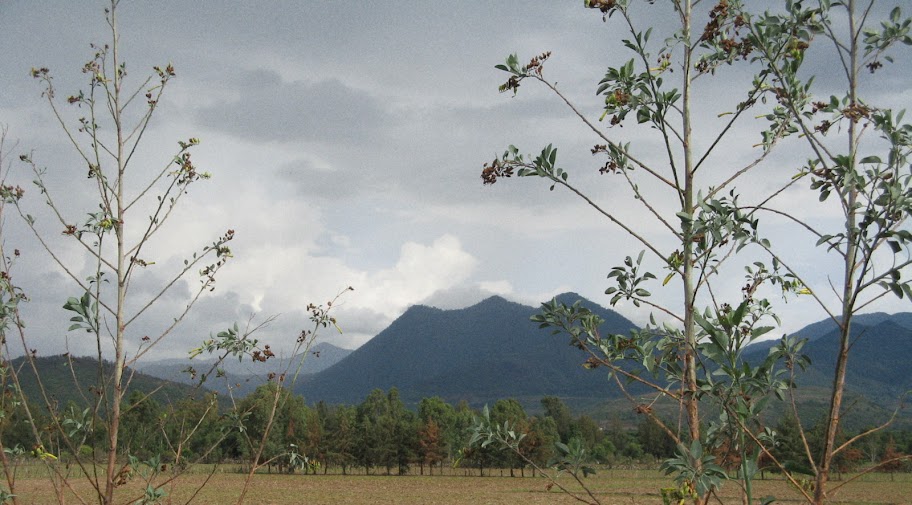 |
| Storm clouds over mountains |
What a surprise. About 6:30 p.m. the rain began. It quickly grew into a wind driven storm. Water forced its way under our living room window onto the tiled floor. That was nothing new. But soon, the wind went crazy, blasting water into our covered porch, then under the double front doors and into the hallway. That was joined by water driven into the garage (we almost always leave the garage door open).
(By the way, it might have been a strong storm, but not one third of the ferocity of the one we experienced last year in Tonalá.)
Then came the hail. We had had hail before, but never as plentiful as this. Our yards looked like una Blanca Navidad.
 |
| July in Michoacán |
 |
| Peach trees on a summers' evening |
 |
| Back yard scene |
The usual procedure in these deluges is to deploy a number of old but thick bath towels along the floor to soak up the excess. This time it was also necessary to bring in the wringer mop bucket and extra heavy duty mop (we have three mops, each one for a special task) and mop the floors. That was fine, as these areas were in need of a mopping.
Then I got down the table fan from its storage shelf and strategically placed it where it could help further dry the hallway floor. I left it on for 4 hours. There are still patches of damp.
Meanwhile, the soggy drenched soaker towels went outside until such time as they could be laundered and dried.
Toward the end, I made hot chocolate as a reward for our labors before snugging down under two blankets and quilt.
I love the Michoacán weather. Tomorrow it could might look like this:
 |
| Morning in the mountains |
Sunday, June 17, 2012
The Sixth Year
 |
| A view of distant mountains |
This month of June is the sixth anniversary since we first saw this house out in el campo. We owe thanks to the late Mel O'Hara for bringing us out here. We didn't actually move in until early August, as we had a house sitting stint to finish.
Our Mexican neighbors still ask us, "¿Estan agustos aquí?", even though we have been here 6 years. Our answer is, "Sí".
Our Mexican neighbors still ask us, "¿Estan agustos aquí?", even though we have been here 6 years. Our answer is, "Sí".
 |
| The house six years ago. |
 |
| Doña Cuevas at the present day house |
 |
| Let me count the bueyes |
PLUSES
+ Relatively low rent
+Low maintenance, mostly done by our...
+ Good landlords.
+ Very friendly neighbors
+ Very quiet neighborhood (keeping in mind that this is still Mexico.)
+ Scenic views of cows, horses and occasionally, sheep. Free manure for Doña Cuevas' garden.
 |
| Bulls on the loose |
+Came with fruit trees, apple, peach and capulin.
± Huge back yard, but underdeveloped.
+All one level; no steps.
+ "Feels safe". Never had a crime "incident", although our former neighbors once had a burglary.
+ All tiled floors, including the garage. Washer-dryer connection in garage. Did I mention the roll down garage door?
+ Big kitchen, with 9 foot long counter/bar, plus cabinets and regular counters flanking the sink.
+ Decent sized dining/living room.
+ Plenty of windows, all protected by fly screens and decorative iron work.
+ Complete lack of local artisan decor. (This, IMO, is a plus.)
MINUSES
- 20 minute drive to Pátzcuaro. Highly unpredictable combi service.
- Eccentric and unreliable Internet connection. (Although it has improved a lot.)
- Lack of English speaking compatriots. We used to have a few, but they left.
- Paint job needs to be redone.
- Inside walls never have been painted. They just have a (used to be) white base coat.
- Some windows leak water during windy rainstorms. We lay down bath towels to soak up the puddles. Occasional roof leaks, but nothing heavy.
We think that the pluses greatly outweigh the minuses. We'll stay a while longer.
Saturday, March 10, 2012
Spring Break in Michoacán
With the advent of Spring like warmth, we at last fulfilled our desire to immerse ourselves in pools of aguas termales. Our top choice for this pleasure are the Grutas de Tolantongo, in the eastern part of the state of Hidalgo, which we visited 5 years ago. However, it's a fairly lengthy trip, so we decided instead to go to the balnearios in the small town of Araró, Michoacán. We first learned of this spot from our friend, Rochelle Cashdan, who lives in Guanajuato.
Araró is situated at the southeastern corner of Lago Cuitzeo, a little northeast of the larger town of Zinapécuaro, Michoacán.
View Larger Map
Although Google Map's directions showed Araró to be about 1 hour 40 minutes from our home, we expected that it would take longer, due to traffic in Morelia and that we stopped a couple of times en route. Not unexpectedly, the autopista tolls were a considerable expense. We didn't keep records, but it was pushing $200 pesos each way. Of course, there are free highways, but they are slower and trafficky. We took a route that passed by the Morelia Airport, which gave us an chance to look into the Restaurante Titanic, a huge seafood restaurant (featuring "jambalaya" on the menu!), but we were keen on getting to our destination so we didn't eat. A mistake.
Route finding was easy until we exited the Guadalajara-México autopista at the Zinapécuaro-Acambaro toll plaza. We missed the sharp turnoff and found ourselves heading to Acambaro in the state of Guanajuato.
But, applying Escherian navigation, we looped back in the direction of Zinapécuaro, asked directions, and got back on track to Araró.
Araró gives the impression of a town trapped in a time eddy. The autopista forms a southern boundary, a mountain ridge the north, and the shore of Lago Cuitzeo the west side. There appears to be one road only down the hill into the town. Signs point the way to Balneario Huingo and its adjoining neighbor, Los Hervideros, just outside the town center.
We arrived very hungry and unprepared, for the food services at Huingo were closed until the weekend. The little tienda sold us a couple of cans of tuna, some galletas Saladitas, and a mini jar of mayonesa. We had brought Boing! fruit drinks, so we had a small feast.
The men's restroom/changing room is adequate but needed some cleaning. The women's was in better condition.
There are a number of pools of various dimensions. I was pleased that those featuring kiddy slides and other juvenile attractions were set apart from the main pools.
There were well behaved children in the main pools, of course. The whole place was relatively tranquil, until later in the afternoon, the PA system started blaring stirring Spanish marches and bullfight music.
Besides the large, luxuriously warm large pool, there's a smaller, covered rectangular pool designated as "Temazcal". The water temperature is 40º C with a depth of 1.40 meters (4 1/2 feet) was what I needed to sooth old injuries.

After a few hours of soaking and changing pools, we dressed and left. We were shown a shorter way back to the town center. We decided to stay the night, and after seeing the spacious and attractive grounds of Hotel La Playa y Balneario*, in the heart of town, we took a room at the discounted rate of $350 pesos (asking price, $500 pesos). The room was new, very clean although a little under furnished. We didn't avail ourselves of any of the three pools on the property, but I did dip my hand in two and the water was tepid.

*There's another hotel, across the residential street at the back of La Playa, called Hotel Wesfalia. It's a very attractive building, but we didn't look into it. There are also other, older lodgings, such as Posada Jazmin and Hotel Esperanza, on or close to the main street. In Zinapécuaro is Posada Los Colorines, apparently a more deluxe hotel, associated with the Reino de Atzimba water park.
We are accustomed to nighttime noises in Mexican hotels, thus we were not disappointed at La Playa: chiefly amplified music until about 10:00 p.m.; plus regular gongs of the church** bells, a block away. The baaing sheep were hardly noticeable, underscored by a passing freight train in he near distance. I didn't realize until morning that we had our earplugs along.
** The church is very attractive, noted for El Señor de Araró and its fiesta, which, I think we just missed.
In the morning, I tried the promised agua caliente las 24 horas in the bathroom and it delivered! It was a great shower, one of considerable force and abundant hot water.
Getting something to eat was a challenge. We saw two restaurants and a comedor económico in town, and none were open during our stay. We ended up eating passable tortas at Lonchería Guerrero and its neighbor, across the main street from el mercado de artesanías.
We bought bread and cheese at a tienda, but didn't eat it until we got home on Thursday. We stopped in Morelia for a decent lunch.
We enjoyed our brief visit to Araró, and will go again. Next time, we'll prepare better and bring some snacks.
Araró is situated at the southeastern corner of Lago Cuitzeo, a little northeast of the larger town of Zinapécuaro, Michoacán.
View Larger Map
Although Google Map's directions showed Araró to be about 1 hour 40 minutes from our home, we expected that it would take longer, due to traffic in Morelia and that we stopped a couple of times en route. Not unexpectedly, the autopista tolls were a considerable expense. We didn't keep records, but it was pushing $200 pesos each way. Of course, there are free highways, but they are slower and trafficky. We took a route that passed by the Morelia Airport, which gave us an chance to look into the Restaurante Titanic, a huge seafood restaurant (featuring "jambalaya" on the menu!), but we were keen on getting to our destination so we didn't eat. A mistake.
 |
| Restaurante Titanic |
But, applying Escherian navigation, we looped back in the direction of Zinapécuaro, asked directions, and got back on track to Araró.
 |
| Araró seen from La Playa |
We arrived very hungry and unprepared, for the food services at Huingo were closed until the weekend. The little tienda sold us a couple of cans of tuna, some galletas Saladitas, and a mini jar of mayonesa. We had brought Boing! fruit drinks, so we had a small feast.
The men's restroom/changing room is adequate but needed some cleaning. The women's was in better condition.
 |
| Main pool at Huingo |
 |
| Kids' stuff |
Besides the large, luxuriously warm large pool, there's a smaller, covered rectangular pool designated as "Temazcal". The water temperature is 40º C with a depth of 1.40 meters (4 1/2 feet) was what I needed to sooth old injuries.

After a few hours of soaking and changing pools, we dressed and left. We were shown a shorter way back to the town center. We decided to stay the night, and after seeing the spacious and attractive grounds of Hotel La Playa y Balneario*, in the heart of town, we took a room at the discounted rate of $350 pesos (asking price, $500 pesos). The room was new, very clean although a little under furnished. We didn't avail ourselves of any of the three pools on the property, but I did dip my hand in two and the water was tepid.

*There's another hotel, across the residential street at the back of La Playa, called Hotel Wesfalia. It's a very attractive building, but we didn't look into it. There are also other, older lodgings, such as Posada Jazmin and Hotel Esperanza, on or close to the main street. In Zinapécuaro is Posada Los Colorines, apparently a more deluxe hotel, associated with the Reino de Atzimba water park.
We are accustomed to nighttime noises in Mexican hotels, thus we were not disappointed at La Playa: chiefly amplified music until about 10:00 p.m.; plus regular gongs of the church** bells, a block away. The baaing sheep were hardly noticeable, underscored by a passing freight train in he near distance. I didn't realize until morning that we had our earplugs along.
** The church is very attractive, noted for El Señor de Araró and its fiesta, which, I think we just missed.
In the morning, I tried the promised agua caliente las 24 horas in the bathroom and it delivered! It was a great shower, one of considerable force and abundant hot water.
Getting something to eat was a challenge. We saw two restaurants and a comedor económico in town, and none were open during our stay. We ended up eating passable tortas at Lonchería Guerrero and its neighbor, across the main street from el mercado de artesanías.
We bought bread and cheese at a tienda, but didn't eat it until we got home on Thursday. We stopped in Morelia for a decent lunch.
We enjoyed our brief visit to Araró, and will go again. Next time, we'll prepare better and bring some snacks.
Tuesday, November 01, 2011
Something Old, Something New: Hotel Refugio Agustino

One of the most recently inaugurated is the Hotel Refugio Agustino, at Calle Aldama # 272, just off Ave. Abasolo.
It's bounded by Málaga, a juice bar, to the east and a Happy Go convenience store to the west. The o.k. Tako Tako Taquería is across the street.
 |
| Patio lobby area |
 |
| Banessa greets you with a smile |
The Hotel is a converted charming Spanish Colonial building with seven rooms. It’s very nice with few deficiencies. There are modest but charming Colonial decor touches throughout: wooden beams, brick ceilings, walls of cantera stone, brick arches. All in good taste, without being overwhelming. Our room was a suite consisting of an ample bedroom with a king bed, a very long, well constructed dresser about 3 meters in length, with mirror, better than average lighting and ample wall switches and outlets; a small kitchenette area with a stainless steel sink and drainboard, a microwave oven and a small cupboard; a tiny breakfast table and kitchen stools.

 |
| foyer of Suite # 7 |
There’s no refrigerator nor any drinking vessels or dishes, other than a couple of glasses out by the water dispenser in the hall. You’ll have to bring in your own food, as there’s no food service in the hotel. But there are many food establishments nearby.
We had ample closets and storage space, although the closets are peculiar in that the hanger rods are at right angles to the norm.
The bed linens are above average in quality and we slept comfortably. There was some ambient noise through the patio doors, but it wasn’t bad, and after all, noise is almost inescapable in Mexican cities.
The bathroom is small but adequate, with a modern flush toilet and lavabo. There were a couple of minor flaws: the vertical stainless steel inlet pipe of the lavabo was not mounted firmly and wobbles a lot when touched. Another, minor detail is that the towel hook swiveled loosely. Not a big problem though.
The attractive shower, just off from the toilet area, in an unroofed stall. The tiled walls and floor are new and very clean. The hot water took about 1 minute to arrive, but when it did, it was forceful and plentiful. In fact, the shower, along with the comfortable king sized bed are among the highlights of suite #7.
Note that as a retrofit, the bathroom is in a partially unroofed box constructed within the suite. The toilet area is roofed in relation to the rest of the suite, but the shower area is not. There’s also a translucent plastic skylight in the ceiling over the shower and part of the bedroom.
A really nice feature to Suite # 7 is the small, private patio, accessed by attractive wooden sliding doors. There’s a small table and a couple of chairs. It would be a nice place for breakfast or afternoon drinks. (You can also dry your socks and undies out there by draping them over the patio furniture.)
 |
| Patio doors looking inward |
 |
| Bedroom in refection |
However, considering the large and uninsulated expanse of the sliding wood and glass doors, I would not want to have this suite in the dead of winter.
The standard rooms are compact but appear adequate. They are arranged for the most part on two levels, a small sitting room below and in at least one, low ceilinged, bedroom loft, up a set of short, broad wooden stairs.

When I stopped by in August for a quick look at the hotel, the low ceilinged upper level was a little stuffy. I would not choose a room that faced the street, because of the noise. There's at least one other suite on the upper floor, which overlooks the lobby, with a Queen bed. Price is the same.
The most serious flaw in an otherwise lovely small hotel was the temporary (?) lack of Internet connectivity. Wireless Internet is advertised as being available in the lobby area. However, when I was given the password and I tried to enter it in my mobile device, it wouldn’t connect. After some time, Banessa ("with a B"), the friendly receptionist, told me that the router was broken, in fact, “burned out”. I was lucky to have access to Wifi at our friend Rosa's Casona Rosa, 2 1/2 blocks away, but it was nevertheless an inconvenience, and not available to everyone.
Here are some informal ratings:
Comfort: ****
Service: ****
Price per room: $$$$+ ($= $100 pesos)
Cleanliness: outstanding
Quiet: Our room, in the interior, was fairly quiet.
Contact:
Tel: (443) 274 9224
Email: refugioagustino@hotmail.com
Website: Click here.
Location:
Location:
Calle Aldama # 272, Centro Histórico, Morelia, Michoacán, México
View Larger Map
Subscribe to:
Posts (Atom)