Sunday, June 01, 2008

The Chicken Dance, Part 2

On arriving at Tzintzuntzan, we easily found parking near the Presidencia. The siren's song was a taco stand, wafting tempting smells of onions and sizzling beef from across from where we'd parked. Little Alejandro was already hungry, so he, María, Amparo and Socorro each ate a few (about 3 each) tacos. With hindsight, I now realize that they knew something we didn't. To survive a big fiesta, you fortify yourself in the early stages.

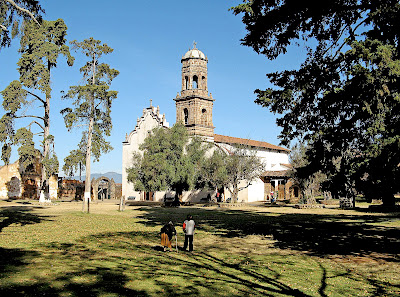
We then strolled onto the beautiful church grounds amidst gathering wedding guests and slow-moving strings of guided tour groups.


Then we waited. The Padre had not arrived yet. After about 30 minutes, I went back to the gate to a tienda de abarrotes (small Mom 'n Pop grocery) and bought some cacahuates enchilados and a delicious "Doblón" snack cake to tide me over. It would be several hours before we'd eat again.

The Padre arrived, and he blessed the congregation, sprinkling all with Holy Water. La Misa proceeded well, with a chorus in the loft. It turned out to be a sincere and enthusiastic group of young mariachis. The wedding was an emotionally moving experience for me, as it always is. The whole ceremony lasted less than an hour.

We then gathered outside again to wait. The wait was made interesting by conversations I struck up with the mariachis, and with a young man, originally from Puebla, who's worked in Seattle for many years. We chatted variously, especially about pulque, its varieties and its health benefits. He claimed that his abuela lived to the age of 133, crediting her longevity to daily pulque consumption.

Una jarra de pulque


The Pulque drinkers


After perhaps 30 minutes, we left the church grounds and ambled along the streets of Tzintzuntzan to a small building, probably a tortillería, across from the PRD (a political party: "Partido Revolucionario Demócrato") offices, where chairs and light refreshments awaited us.

Then we waited. A long time. About 2 hours. It felt like more.
Time passed like inspecting lentils for pebbles.

Studying the surroundings. Cardboard wall partition to the right.
Chatting about making pizzas.
Going to the semi-open
baño at the back of the still under construction building.
Wandering out to the street for relief from the occasional fumes of insecticide drifting in.
Looking at the several attractive women among the various others waiting.
Going out for snacks. (see below.)
Turning down offers of Tequila being passed down the line by our gracious hosts.
Another store, across the street, held more waiting guests. They also waited in chairs along the sidewalk.

After more waiting, the newlywed's party finally arrived, banners waving. While everyone else went to the Salón de Eventos La Diana, we walked the 6 or 8 blocks back to our car, in order to pick up the gifts.

Vendedoras with large baskets of pan dulce walked by, and we bought a few breads to hold off increasing hunger. I bought a largish flat brown bun that was too coarse and dry to eat without some beverage in which to dunk it.

Farther along, we were saved by a stand selling hot freshly cooked chicharrones—fried pork skins). They are in large, curly pieces and delicious with or without a dash of Valentina Salsa Picante. Hunger was relieved.

Good sense prevailed and we drove back streets to within one block of the Salón Diana. Maidens showered us from their baskets of confetti as we entered the impressively carved doors of the Salón. The huge interior, large enough for a livestock exposition, was beautifully decorated with festoons of white "stalactites" joined at the junctures by hearts. Far ahead in the semi-gloom I could see table after table. There may have been more than 50 long tables.

There were also several pre- main event diversions, which I'll discuss in "The Chicken Dance, Part 3"

The Chicken Dance, Part 1

I've said it before: you have to be strong to party with Mexicans. They have the fiesta thing down, while we extranjeros feebly struggle to keep up. Fiestas seldom happen as one off events. No, they at least come in pairs and more often than not, series of parties over a week or two.

For example, we'd been invited to a small family get together on Friday at the home of our neighbor, Sr., Jesús O. and his wife, Praxedes. Only 15 or 18 guests, family and friends, gathered to celebrate Sr. O.'s Día del Santo.

It was a nice, quiet, family affair, with home made mole de pollo y arroz, the ubiquitous 2.5 liter refrescos bottles, and some cookies and bread pudding that I'd made. Our tablemates and I conversed on Las Vegas, Nevada, its attractions and its downsides.

Ah! the first Cocteles Margaritas I'd ever seen served at a local party made an appearance. (It's those gringo influences, learned al Otro Lado, infitrating La Cultura Mexicana.) I will say, however, they were done in a distinctively local interpretation, served in vasos plásticos deshechables.

Later in this intimate gathering, our amiga, María de la Luz B. asked if we'd like to go to a dance the next day, in Tzintzuntzan. I didn't understand at first, thinking she wanted me to dance with her. If so, she was joking, as I have a well-deserved reputation for two left feet. Our landlady, Sra. "Chucha" B., seated next to me, further explained that there was to be a wedding at Tzintzuntzan on the morrow, and that we should attend. The big draw would be the performance of La Danza de Pollos.
Wow! The Chicken Dance???

I was, of course, intrigued. They sank the hooks deeper as they skillfully played the line, with mentions of The Cerveza Dance and the Dance of El Torito. The clincher was that these dances were unique to Tzintzuntzan (only a few miles away over the ridge or a bit longer by highway) and not available here, in Las Cuevas.

Who could resist?
"O.k.", I declared. "¡Estoy convencido!"

We made plans to pick them up for a ride
at 10:15 Saturday morning to the mass, scheduled for 11:00, and after to the festivities. (No one really believed that we'd really leave at such a ridiculously precise time, but we all went along with the concept.)

At 10:20 Saturday morning, Sra. Chucha was ready. María and son were not to be found. We rode down the street to the highway, turned towards María's house, and found her by el vado, walking towards us, with Sra. Amparo and her daughter, Socorro. After turning around, we stopped in front of the house of Sra. Lupe, one of Sra. Chucha's many sisters, and offered her a ride. The van was able to comfortably carry all as we'd put in the rear bench seat earlier in the week.

By 10:35, we were off towards Tzintzuntan's venerable churches, set in a lovely area of
ancient olive trees.

Monday, May 26, 2008

The Upper Las Cuevas Cinema Society


I was reading Todd McIntosh's blog, "Life In The Corazón" about the launching of the new, deluxe, VIP Cinépolis theater at Morelia's Plaza Las Américas. I left a comment, one long enough to cause me to realize that it was really the beginning of an entry for this blog.


We haven't been to a movie (in a theater) since we moved to the area in September, 2005. It's not that we haven't tried, it's just that the selections on the playbill are so...unappealing.

I don't think that First-Class reclining chairs, with Crepas de Sushi a la Cajeta are a big enough draw for me. They have to get some decent, interesting films. I don't mean Alvin and The Chipmunks Take el DF. Also the ticket prices are at least the same, or higher, to what we were paying back in Little Rock, Arkansas.

Lately, on various bus trips to Mexico City and Oaxaca and back, the quality of on-board movies seems to be rising They're not just the stock, chop-socky: Predator, Rambo Meets The Vampire Gang, and Danny The Dog Gets a New Leash On Life. Now there are some love stories, family fare, and Becoming a Man Aboard a Sailing Ship In The Summer While Losing My Virginity. There was a pretty good movie, which we saw twice, about the Lafayette Escadrille in WWI in France. It had these little aeroplanes in it. That was cool, once.

Now Todd, if you and Shannon are old enough (60 years +), you can qualify for an INAPAM Senior Discount Credencial that will give you movie theater discounts as well as half price bus fares between cities. You don't look anywhere near old enough, but Wait!, When you qualify, you can take the AutoVías bus to Mexico City at 1/2 price, while watching two free movies, sipping your BOING! natural fruit drink or agua embotellada. Sometimes, there's a sandwich, too. This is something to look forward to. Trust me.
No, nosotros los extranjeros of Upper Las Cuevas have the pleasure of seasonal movies under the auspices of our peregrinating friends and neighbors, Larry and Geni. Larry has rigged a projector to his computer so that we may watch quirky Film Classics, often of the Noir genre, beamed onto the white-painted walls of their Sala Grande. We sit in Director's Chairs, with cup holders, and munch popcorn while watching a knockoff version of Casablanca, for example. These are incomparable, home-grown type cinema experiences. I really doubt that Cinépolis VIP can even come close to equalling these evenings with our friends next door.

Wednesday, March 12, 2008

Capuchinos, Cortados y Canciones de Pájaros

Yesterday, sitting in the Café La Lucha, off the Plaza in Uruapan, we were sipping capuchinos fríos and cafés "cortados" (really cafés Americanos with hot milk foam on top, as served there)

As we enjoyed the strong, flavorful coffee, we saw an old man walk in. He stood in front of the table nearest the door and began to make bird songs. His only instruments were his mouth and throat. His skill was remarkable.

After a while, he came to our table and entertained and delighted us for a few minutes. We gave him a modest tip, and he thanked us with blessings.

After he walked away, we realized what an opportunity we missed. Three of us had digital cameras with video and audio recording capability. We'd have gladly given him a more generous tip in order to record him doing "Lullaby of Birdland".

Due to our oversight, you, dear readers, will have to be content with a photo of a capuchino frío.

Below is a slideshow of photos taken last year, in Uruapan's Parque Nacional Eduardo Ruíz. More, and better ones from yesterday coming eventually to this site.


Friday, February 22, 2008

Spot; A Dog of the South


"Life in Mexico for the retired American is not all cerveza and totopos with your guacamole. But the rewards are worth the occasional annoyances."

A recurrent theme here is that sometimes there're bugs in the guacamole.

So it was with mild disgust that we learned on return from our trip to Oaxaca, that the outside of our brick perimeter wall was (dis)graced by a perro muerto. My immediate instinct was to ignore it, for the bichos y los zopilotes would soon consume it.


X Marked The SPOT

That was not the case. As the week passed, the odor grew more fetid. I considered burning it with gasoline, but that would leave a big stain on the wall.
I had some calcium carbide, used in old miner's lamps, but I doubted that was enough to have any positive action.

Finally, the day before yesterday, I asked Sr. Mateo if he could do something about it.
He said that he's drag it off "arriba", and he did. I don't want to know where "arriba" is.

The smell still lingered at the spot where Spot once lay. I resorted to tossing buckets of cold water, heavily laced with Pino Sol. The smell is starting to dissipate.

I want to know why are the zopilotes so picky, and where were they when their services were needed.

Thursday, January 31, 2008

Las Señoras Suben Al Cerro

Yesterday evening.
I'd just returned from an evening walk with the Señoras of the community, up the road towards Sta. Cruz. I'd gone out idly, just to take a little air. En route, I stopped by Sr. Santo's cow lot down the street, where there were two, newborn calves, a black and a black and white. They were eagerly suckling leche, while one mother cow licked her young, the other stood quietly, even as he lunged for the udder.

Down by the capilla, the ladies gathered prior to their walk. They receive a monetary encouragement from some governmental department. Their custom is to make this walk every Monday and Wednesday at 6:00 p.m.

I'd gone with them about a third of the way up on a previous occasion, but this time, walking paso a paso, I found it quite easy. I was surprised when the vanguard turned around before la última subida.

They conversed quietly among themselves in their small groups, or walked silently. They were in every type of physical condition and ages were from a child to an bisabuelita (Great Granny, I'd guess.) All are invited to participate, but los hombres almost never do so. I'm the only one I know of. When I once asked about this, I was told "Ellos prefieran sus cervezas." —They prefer their beers.—

When I said to María, who recently lost her mother, that the walking was "Buena para la salud.", she answered, "Buena para la salud, y para el alma." She was correct.

At evening, the views of the valley and the mountains beyond, fill the eye with their beauty, and gladden the soul.

Saturday, January 19, 2008

The Dust of Tzurumútaro


Nose to the ground, north of the tracks, back on his feet...

(Where your blogmeister has an intimate encounter with La Tierra Mexicana.)

On the way back from getting a gas cylinder filled at Global Gas, we stopped in Tzuru just before the pollos asados al carbón place. I checked out the attractive watermelons nearby. The prices for them seemed high (I don't know, is 50 pesos a lot for a small one?) I decided not to buy any, thanked the man for the generous sample, and walked away.

Suddenly, the ground rose rapidly to meet me.
BAM! I hit the ground, my nose the impact point. I lay there a moment or two, assessing the damage. Susie came over and the watermelon man gave me a wad of clean toilet paper to stanch the copious bleeding. Mi sangre mezcló con el Polvo de Tzurumútaro.

I then went to the car, where I reclined, pressing a couple of wads of paper against my nose. After a little while, the bleeding stopped. There isn't much pain. I guess nothing is broken, gracias a Dios.

We went ahead and bought a chicken and a bag of ice to help if there's any swelling.

Once home, I cleaned up and changed clothes. Took a couple of Ibuprofen for starters. I don't think I'll need medical attention. (For a change!)

It was nowhere near as bad as the fall I took near Don Chucho's store in 2006. My appetite is unimpaired, and we're about to tuck into the great Tzurumútaro pollo asado al carbón.

I can't decide if I want a Tequila or a beer with it. Maybe both?

Later...

The pollo asado never tasted better. We ate the whole frickin' chicken. The salsa roja supplied by the roasters was unnecessary The accompanying slaw-like cabbage was clean and zesty.

Maybe this is a new technique for enjoying one's food to the max; something like burning down a house to roast a pig.

I had a beer, 2 more ibuprofen and a lie-down. Next, the ice pack.
Nose on the rocks, anyone?


Friday, January 18, 2008

Mexican Fireworks

On the Thorny Tree Refuge forum, we were discussing what made us want to travel.

" Many of us have travelled whether we wanted to or not -- being hauled across countries or continents by our parents, or being forced to relocate for some other reason. However, the fact that we are on this website after having been on the previous one would appear to indicate that travel is now in our blood. So, what made you want to travel? - "Kerouac2"

This was my answer, which I'll elaborate here. It's not the only reason.
As a child, I lived/visited in Montreal, Quebec for a couple of years. Nothing exotic about that, really, except for a holiday to Quebec City.

But in another place, I was enthralled by a children's book, called "Mexican Fireworks" . (I'm sure that it was very romanticized and "unrealistic".) In my adulthood, I had the pleasure of seeing real Mexican fireworks.
Near the town of Tepoztlán, Morelos, I even saw the fireworks being assembled by coheteros create a "castillo".


The brilliant moment came the night of our arrival in Pátzcuaro, Sept. 28, 2005. It was my 63rd birthday and the 300-something years anniversary of the city. We went to the Plaza Grande just before 10 PM, where we stood amidst the cannonading and bursting pyrotechnics. It was a wonderful bienvenido.

¡Gracias, México!

Thursday, January 17, 2008

Alcatraces y Cenizas

Yesterday, we experienced our first Mexican funeral. It was different than I anticipated. It took place in the small, somewhat isolated village of Sta. Cruz.

The deceased, the mother of a friend of ours, had died suddenly ten days before. It seemed odd that interment would be so long after death, but from our bereaved friend's laconic comments, we thought that perhaps the body was cremated.
This was the case, as we saw yesterday upon reaching the humble home of
la difunta y su viudo.

The mourners inside were gathered around a black box a little wider than a shoebox. In it were the mother's earthly ashes. The box was on a chair, flanked by tall candles and lovely, long stemmed
alcatraces lilies. A rosary was recited by the gathered friends and families.

We stood the entire time outside in the yard, then, when the prayers were over, went in to comfort our friend and her sisters and brother.

We then adjourned to the nearby church, where the Padre had already begun
La Misa. The church was incongrously still festooned with Christmas decorations, including pink and white balloons on the walls. The Virgen de Guadalupe looked upon the congregants with a benevolent smile.

We'd been to several masses since moving here, but I'm not familiar enough with Catholic liturgy (especially in Spanish) to distinguish the variant types. To me it seemed that only at the end of the service was attntion specifically directed to the deceased and her family. Afterwards came the usual announcements by the Padre about fiesta dates.

We returned to the house, where we took seats and were served
corundas de pollo con salsa y crema, y arroz.

When all had eaten, the debris was gathered and the folding chairs stacked inside. Most of the visitors left, except for the immediate family and a few friends.

We then carried several passengers to the
panteón near Las Cuevas and Nuevo Rodeo.


The interment was brief. The
viudo, an adult son, a young granddaughter and others scratched out a shallow hole in a grave mound. The black box was placed in the hole, and earth brushed over it. They said few more prayers, the Padre Nuestro, then a hymn was sung. The flowers were distributed over the grave mound.

The family then departed for Quiroga, some 20 minutes away, hoping to arrive in time for the next
misa. We, instead, carried two amigas back to Las Cuevas in our van.

Monday, November 12, 2007

Clip Joint


I am not a vain person. So it is, that I prefer to spend a minimum of money on personal grooming. For me, it's whatever gets the job done.
Soon after our arrival in the Pátzcuaro area, our first landlords recommended a hair stylist. Guillermo is a fine gentleman, but in my mind, his skills were wasted on me. Let's face it: I just don't have that much remaining hair to warrant paying $70 to 80 pesos per haircut.

Neither do I want to go to extremes. Along one perimeter wall of Pátzcuaro's mercado are barber stalls of varying elaborateness or primitiveness. I'm not sure, but I think you can get shorn for about $20 pesos. However, the ambience of those places no me llamaron la atencíon.

I found a haircutter's shop on the side of the Plaza Chica which seemed to specialize in children's haircuts, judging from the colorful seats in the form of ponies, boats and airplanes. They did a pretty good man's haircut for about $30 pesos. But then, it disappeared. Out of business, replaced by a sombrero shop. What could be more appropriate?

Up around the corner, on Calle La Paz is Estética La Paz. It's one big room, staffed by attractive señoritas and señoras. How could I pass this up? They are efficient. I can go in, sit down, and emerge 15 minutes later all cleaned up.

I even trusted my neck to their razors. At the previous place, I was afraid of dire infections that might be transmitted by razors. At La Paz, (and probably at the others) I realized that they used a fresh, disposable blade for each client. (A side benefit is that it's not exactly an unpleasant experience when the lady barber applies the warmed, soapy solution to your neck and ears. Mmm.)

A haircut is only $25 pesos. That's currently $2.30 US. At that price, I can afford to leave a decent, but not ostentatious tip.

Sunday, November 04, 2007

Los Compañeros del Panteón


Day of the Dead 2007

We'd not planned on visiting the local cemetary this year, but Alejandro, María's youngest son, accompanied by Socorro, a young woman friend, came to our house to invite us. About 30 minutes later, Javier, the 15 year old son arrived to tell us that the invitation was for the day, not the night, and that we should bring something to eat.

Perfect. I was about to put two raisin challahs in the oven. We could bring one of those and a dozen cinnamon rolls I'd made earlier.

The weather was beautiful, clear and warm. We arrived as Padre Serafin was beginning the mass. It was a long service.

Meanwhile, kids were running around playing on the wall, and a nieves vendor was doing a good business outside, on the road. It seemed as though limón, in a lurid green color, was the favored flavor.
After the lengthy reading of the names of los difuntos, we gathered by the stone wall for our lunch.

The picnic, organized by our friends and neighbors, was nearly as simple as it gets: frijoles de olla, sopa de arroz, chicharrón en salsa amarilla. I hate chicharron en salsa, but I was able to get some crunchy chicharron and thus avoid the slimy stuff. María and Rosa sang a very long hymn about Mary, Queen of Heaven, as they helped prepare lunch.

I broke the freshly baked Raisin Challah, saving the Cinnamon Rolls for a dessert. I made a point of saying a few words about the Latin origins of the Spanish word, "compañero/a". Compañeros are literally those who share bread with each other. The cinnamon rolls were especially coveted by our friend, María, but she "released" them so that others could share.

Little Carina asked me why I'd brought a camera but wasn't taking any photos. I told her I'd doubts as to whether it was respectful to take pictures in the cemetary. (That little girl is very perceptive and outspoken. She has now told us that she wants us to teach her English. I bet she could do it, too, if you could suppress her boundless energy for 30 minutes.)

She gave me the ok to photograph;"you can do that here, no one minds". That was confirmed by an adult.
The visit was climaxed by her discovery of a fat green, caterpillar, accompanied by girlish shrieks. After making sure everyone saw the creepy grub, she daintily folded a napkin around it and stepped on it. Bleaah.

After we left the cemetary, I felt renewed and revived. However, those feelings were short-lived the following day, as we began to itch from numerous chigger bites. I suppose they are another reminder that we are made of mortal flesh.

Friday, October 26, 2007

Senior Discounts Para Extranjeros


A while back, we learned that foreigners resident here, such as ourselves, could apply for and get Senior Discount Cards from the Mexican government department known as INAPAM. It used to be called INSEN. Now it's Instituto Nacional Para Las Personas Adultas Mayores

Considering the many economic benefits for nosotros los extranjeros that we already have, this seems an act of unbounded generosity on the part of the Mexican government. But we are loath to turn down discounts and free offers, especially when they come without any "catches".

In theory, we could have obtained these cards when we arrived to live here, but two years plus passed before we got around to it. There are many other, higher priority tasks to be accomplished before this one.
On Tuesday, we went to the office of the INAPAM delegacíon Morelia.

Mariano Jiménez #592, Esq. Av. Solidaridad, Col. Nueva Chapultepec, Morelia, Mich. C.P. 58260
Tel. y Fax: 01 443 314 35 22 Tel. 01 44 33 15 92 47

The process was very easy. There was only one client ahead of us. (There was only one worker at that point. A bit later, another came in.)
I explained what we had come for, and she asked if we lived here permanently. We showed her our FM3s and passports. We already had color fotos infantiles which we'd had made at Farmacia Guadalajara in Pátzcuaro.

The INAPAM lady didn't ask to see our birth certificates nor our comprobantes de domicilio, all of which we had brought, just in case.
We signed the cards, she glued on the photos, laminated them, and we paid 5 pesos each. That was it. It was very informal and non-officious.

They had run out of the pamphlets of affilated businesses that offered discounts. When and if those become available, ¿quien sabe? Meanwhile, it doesn't hurt to ask when shopping. We do know that some inter-urban bus lines offer 50% discounts on fares, although a limited number of seats are allocated to this. That alone, plus discounts at some farmacias are substantial benefits. Other Senior services are provided, depending on where one lives and availablity, although we are less likely to avail ourselves of those.

This 3 mb PDF file lists some of the benefits and affiliated businesses offering discounts, but it's focused primarily on México, D.F.

We would like to say "Muchas gracias al Gobierno Mexicano y a la Delegacíon INAPAM de Morelia por su generosidad."

Sunday, October 14, 2007

Chasing the Shadows with Flowers


Sometimes gloom settles heavily on the psyche. It may be from lack of activity or perhaps from the weight of years, with its attendant ailments. Or it could be a vitamin deficiency.

But few treatments are as effective as a vigorous walk for an hour or more, preferably in the late morning. Now is the optimal time of year for walking, with clear, sunny skies and pleasant temperatures. But the splendor of the wildflowers that appear in September and gallantly resist the scarcity of rains has a specially therapeutic effect.

The flowers along the roadside dazzle with their colors of pink, gold and deep blue. The fields not in cultivation are spread out in pink blankets of cosmos. Girasoles (sunflowers) beam cheerfully on their long stalks. The mountains form a steady green backdrop to the impermanent but welcome floral displays of this season.

Today, after the sun comes over the hills and when the morning fog lifts, I'm going for a walk amidst the flowers.

Thursday, September 27, 2007

Radiation Therapy

A few days ago I found antifreeze fluid on the otherwise shiny tile floor of our cochera (garage). After a brief day of procrastination, we took the Windstar into the radiator shop of the Refacciones Santa Clara, located on the Libramiento (free bypass to the Pueblo Mágico, Pátzcuaro. The Libramiento is the gritty, working part of Pátzcuaro, not mentioned in tourist guides.)

The radiator shop is across the busy street, where heavy earthmoving equipment is chewing up the sidewalks and widening the avenue, to the incessant noises of vehicle backup warnings.
The dingy shop has an old sign, "El Chumina". I have no idea what that means or if it's relevant to the present day operation. Its next door neighbor is the municipal car pound, populated by wrecks and tow trucks.

Javier, the Chief (and only) Mechanic of the Radiator Shop, listened to our problem and presented us with various options. In the end, only one seemed to make sense: pull the radiator and check it and its peripheral connections for leaks.

Usually we don't linger to watch our car undergoing surgery, but as we were already there and there was no waiting, we hung around. At times it was scary. I'd never seen our car's engine eviscerated before, accompanied by various gases and liquids hissing and sizzling as lines were disconnected. It all ran out onto the pavement and into the gutter. As the collection of bolts, screws and bigger parts grew alongside the car, so did my queasiness. But in watching him work quickly and dextrously, I had confidence that all would be well.

Javier would examine the undercarriage by lying on a large sheet of cardboard box.
After an hour and a half of dismantling, he pulled the radiator and took it inside to test in El Tanque. This is a painted metal tank with an overhead beam, spanned by a couple of narrow wooden boards. The contents of the tank would probably give the Environmental Protection Agency fits. A rubber cup or two was fitted over the inlet/outlet of the radiator, then submerged while a hose blew in compressed air.
The radiator passed the leak test. Much tension was relieved when one of the rubber cups blew off with a loud pop and shot out of the tank. We all laughed.

Meanwhile, during the dismantling, he'd found a cut line. How the line came to be cut is a mystery, as it is difficult to access. Measures were taken to prevent cutting the other line.
Then the reassembly began. Somehow this went faster than the disassembly. We went to the nearby food stand and got refrescos for ourselves and for Javier.

In about an hour and twenty minutes, all was assembled again, in a state closely resembling its previous one, except without antifreeze and Freon and a small loss of transmission fluid.
One hundred pesos to Javier, and he wheeled off on a bicycle to a friend's supply place for the antifreeze.

Next. we turned on the engine, and ran it a while to dry out the radiator and for a final check for leaks.
Our minds were silently turning over how much the final bill might be..."four hours hard work...no estimate...gringos inocentes...et cetera..."
In the end, the labor bill was $280 pesos. Nothing for parts. One hundred pesos for the antifreeze (we took the remainder home with us). We gave him 300 and called it even. About $27.45 USD.

Tuesday, September 25, 2007

The Secret Language of Plants


It's been found that plants are able to communicate amongst themselves in a complex but poorly understood way.
If one plant in the network is being attacked by insects, it communicates with the others, who then fortify themselves against the attack.

There are vines of spiny chayote here that grow rapidly and in an almost aggressive manner. They quickly form intertwined networks, covering walls and rooftops in a green tangle as their ugly, spine-covered fruit develops. The gourds dangle like spiny green reptilian huevos. (A few weeks ago, we were given some boiled chayotes. Ugh. They were bitterly metallic in taste and didn't even smell good.)

But then, when millions of little grasshoppers come and start humping in an orgiastic frenzy, munching on the leaves to sustain their activity, the chayote vines are quickly reduced to ragged remnants. There goes the network.

If you were to walk with me in the morning along the Las Cuevas road, the valley enveloped in mist, plants of innumerable varieties sprouting from every crevice in the stone walls, lines of eucalyptus trees forming a fog-shrouded palisade against a backdrop of lushly mature maíz, you would wonder at what the plants were saying to each other. What piropos are passing between the macho tassels of corn and the female silk? There is an herbal oloroso, an odor of fecundity there.

In my more fertile fantasies, I imagine amantes slipping out of their casas in the dark of the half-moon, furtively meeting in the furrows to make
pollen-dusted love amidst the corn rows.

The plants are whispering chismes as the tassels shake over the silk.

Wednesday, September 19, 2007

Jeepers, Creepers


We are fortunate to live in a region of a rich biota. Besides placid cows, noble horses, wonderful songbirds and soaring white egrets, we have the Dark Side of biology as well. Out in the rock pile in the back yard, and now scuttling along the base of the wall surrounding our compound, a fat lizard makes his or her way, searching for prey. I have no issues with the lizards, as long as they stay outside. Fat and shiny horned black beetles creep slowly under the burden of their carapace out on the "porch". Sometimes we find them inside. They seem to spend a lot of time on their backs.

The baño is especially congenial to creepers, owning to the moist environment and the floor drain that connects to the general drainage to the septic tank in the back yard. The concrete slab covered septic tank has two PVC pipes that serve to vent off miasmic effluvia, but look like periscopes on a land locked submarine.

The prevalent bathroom denizens are the pill bugs. They are small and harmless and make only a slight crackle when you squash them. Sometimes there are ferocious looking spiders of considerable girth. I would like to leave them unmolested so that they can devour the insects. In the end, I can't bear the thought of a nocturnal encounter with one of them.

Only once have I seen a scorpion. It was an itsy-bitsy baby, on the bathroom floor. I whammed the living crap out of it with my shower shoes. Last night, as I prepared for bed, I spotted a large, ferocious spider, camouflaged to match the brown curtain (near MY side of the bed) on which he/she was lurking. Its liquidation was a challenge, as I had to apply sufficient force to kill it without breaking the window glass. I used a paper napkin to delicately complete the shuddery task.

I made sure I inspected the bedclothes before slipping into bed, and spending a restless night.

Monday, September 10, 2007

A Dark Visitor

"It was a dark and stormy afternoon." one day last week. I went out to the veranda to watch the storm. There I had a surprise: a very large and dark Moth was resting on one of the carved wooden shutters. I went quickly into the house and got my camera. The photos do not do justice to this quiet and somber creature.

This morning when I went out onto the porch to turn of the light for our departing neighbors, I had a second surprise. There was a silent flutter of wings and a swoop as something flew into the open door. I thought it was a swallow.

Drat! I really dislike having birds in the house. But when I turned on the light, I saw it was the Moth.
Now, I have no problem with a temporary visitor, as long as he is quiet. But i wouldn't be pleased if the Moth were a female, looking for a place to lay eggs.

OOPS! There goes my sweater.

Saturday, September 08, 2007

Pinturas, Gas, y Almohadas

Since our return from a visit to California, there haven't been very many events to report here, so I have collected some small things that might give a glimpse into our life here.

This week, our landlord's teenage son and his friend came to finish painting the decorative, dark blue band around the base of the house. I joke that it's a barrier intended to keep out evil spirits. It really adds a touch of class.
It only took them a couple of hours to do the job, having marked a more-or-less straight edge for the upper limit, then kneeling on the tiled floor to apply brush strokes. They kept an old string mop handy to clean up spills.
The outcome was slightly irregular, but we are satisfied. (Especially considering that it was at no cost to us.)


Since we moved here over a year ago, we've noted the various mobile services that drive in regularly; for example, the propane gas trucks, each with their own distinctive recorded, often musical pitch. My favorite is the one that starts, "Señora de la casa, aquí viene Gas Del Lago, su gas de confiAnza...". It's backed up by a string orchestra playing dreamy, romantic music.
The most disliked is the rival company with the raucous pitch of bugle charges and loud cries of "¡GAS! Toodoo loootle too to doo! ¡GAS!" But, they sell good gas.
Gas Express trucks pitch a come-on which involves a series of prices, something like, "How much would you pay? $32.99? NO! Only $26.99!" I've never quite understood it exactly.
Incidentally, all the gas trucks charge about the same per tank, and they all accept the empties, no matter from whatever other company. I like that.

Now, I have just discovered, on the Gas del Lago website, that you can order gas by Internet! What is becoming of the old values and traditions?

We also have trucks of varying sizes and types bring foods such as fresh, hot tortillas, vegetables and fruits, and even pan. There have been mobile vendors who offer cleaning supplies in bulk. The housewife brings out the empty 2 liter refresco bottles, and gets a fill up out of drums of Fabuloso o Don Limpio at a good price.

In contrast to the regular mobile vendors, there are occasional passing salesmen on foot. We have seen a man laden with cheap, enameled kitchen ware; another hombre carrying a table for sale, on his back; a young man hefting long planks of wood for sale, at $250 pesos each (seemed a bit high to me); and the oddest of all, a few days ago a man walked up our street, crying out something about "¡Almohadas!" (pillows.) I went outside to look, and there he was, carrying 6 or more pillows.
We can sleep well, knowing that there's a source of pillows nearby. (Sometimes).

Sunday, July 01, 2007

Upside, downside

For about two weeks, our house has been a construction site. Our friendly neighbors and landlords decided that the time had come to put a new roof on our rather plain house. (Yes, outside it was plain jane; inside, it's glorious; but the truth is, it's really Gloria's house. She's the daughter that lives in the Silicon Valley area in California.)
Gloria has good taste, and she wanted her house to have a traditional techo tejas, the terra cotta tile that characterizes many Mexican rooftops. The corrugated metal lamina wouldn't do.

A master albañil (bricklayer) was hired to plan and oversee the work. The workers for the most part were members of our landlord's immediate family; Mateo, Chucha's husband; Armando, their son-in-law, and Beto, their teenage son. For a couple of days there were also a couple of temporary workers, hired mostly to peel the red cedar logs that were to provide much of the support structure.

Well, this is one longish story that is going to be made short. In about two weeks of some noise and mild disruption, all of which we suffered cheerfully (the most significant being that our Internet reception was down for the last week), the work was substantially finished last Wednesday.

To show our appreciation, I'd been baking and cooking cookies and pastries for the workers and family on a fairly regular basis, but on Wednesday, we made a comida of vegetable minestrone, vegetables in a light pickle, lasagna; and for dessert, fresh pineapple accompanied by Chucha's chongos, rennet milk curds cooked in brown sugar syrup. I think that we all had a good time.


And, on Friday evening, our ISP man, Bolívar, came and worked under rough conditions to successfully restore our Internet service. Next, the outside of the house will be painted a light blue. It's like living in an almost new house. We hope to contribute to its improvement by redoing the kitchen sink, getting some repairs on the bathtub (a remarkable item in a Mexican bathroom), and starting to repaint the interior.
All in good time.

(Speaking of time, yesterday was the first year anniversary of our renting here. Today, we signed a new lease for another year. The rent stayed the same. And, to top it off, the men are painting the house a lovely sky blue.)

Sleeping In Tongues

Tonight, as we were sleeping, the cell phone rang (that semi-comprehensible, voracious money-sucking Instrument of the Devil). I sleepily answered to the voice of a woman speaking Spanish and very basic English.

After a moment I understood that the voice on the other end belonged to the wife of the private driver I'd called earlier in the day, but with no answer.
I conversed glibly and seemingly fluently with her in Spanish, as we set up an appointment for a ride to the bus station early Wednesday morning. The driver, Sr. Nacho Vega then got on the phone and confirmed the appointed time and address.

When the call was over, I marveled at my new found fluency. Maybe sudden waking from sleep was the answer to my Spanish conversational challenges? That definitely wasn't the situation back in 1992 when a friend in Chihuahua phoned our hotel room at 10:00 p.m. We had had to immediately switch to English to understand each other.

On further thought, it was a subject for which I had been preparing. Then I also recalled a few grammatical slip-ups, such as using "nos trayó" for "nos trajo" ("he brought us" ); and really, "nos llevó" ("he carried us") would have been better.

But overall, I was amazed and proud that I'd been able to wake up and communicate well enough to make the appointment. I returned to bed and slept the sleep of the smug Spanish student.

Wednesday, June 20, 2007

Drinking the Kool-Aid

We enjoy life in a small, Michoacán community, and we feel welcomed and accepted by the local residents. It's especially a nice feeling to be invited to community events, such as the school year end ceremonies that took place on Monday.
As with most of these events, food and drink are involved, and Monday's event was no exception. When I showed up, just at the right moment, I was handed a plate heaped with rice and a turkey leg, covered in dark, rich, home made mole sauce. Yum!
Then I was handed a cup of Kool-Aid. The moment of truth was at hand.


We have a personalized approach to the question of potable water. We have been repeatedly told, in all sincerity, that the local water supply is pure and clean, and that we can drink it from the tap in confidence. However, because of our norteamericano hang-ups, we drink purified bottled water, and use the tap water for cooking and washing. The caution is because we have occasionally suffered some intestinal illnesses, with complications, and we do what we can to avoid these. They are probably totally unrelated to our water supply, but this system makes us feel better psychologically.


I looked all around the assembled diners, and all had cups of Kool-Aid. Well, ok, then; down it went.
I'm pleased to report that no ill effects resulted. I would have preferred a cerveza, but this was a school function, after all.
Sometimes it takes a little longer than usual to adapt to life here. For us, it's coming up on two years.
¡Salud!

Wednesday, May 02, 2007

Las Sequías

Now is the dry season. The hills are sere and the grass is crisply dry. Clouds of silent flies congregate outside of our kitchen on the window screen. Despite the dryness, the jacarandas and the bugambilias are in full, glorious flower.

Since Sunday we have had no running water. The pump that serves our pueblo had broken down, and the needed part was not available in Pátzcuaro. Tuesday was a holiday, El Día del Trabajo—Labor Day, so, ironically no one came to fix the pump. However, tonight I lay in bed, dreaming of rains, and when I awoke, Susan asked me if I'd heard the tinaco filling up (the water storage tank on our roof). It was not a dream. The rains had not yet come, but the deep well that serves our pueblo of Las Cuevas was receiving water. Water is more important than holidays. In a month or so, the rains will begin, ¡ojalá! We will revel in the afternoon downpours and the nightime drizzling rains.

I went outside, at 1:50 a.m. and turned on the water heater. I, materialistic gringo, will soon luxuriate in a
deep bath of hot water.


REPRISE: repeat above scenario, almost exactly one year later. Same resolution. Must be an annual ritual.

Saturday, April 28, 2007

The Road To Tolantongo part 2

The next morning, after a light, in-room breakfast, we packed a small bag for the walk to the caves. There are paths at several levels, but they all converge at two set of steps up to the base of the headwall. Our path started to the left of the buses parking, and to the left of a large, 2-storey building containing the Visitors' Baños. The trail is well maintained and pleasant. About halfway, there is a large and interesting tree.


The bizarre shapes of this contorted tree may give rise to lurid thoughts in fertile minds. Keep your head down and your mind clean when walking by the tree. Near the base of the stairs to the caves are a gift shop (open when we were there), a cocina económica (open on weekends), and a guard. The stairs lead under a small, lush tropical garden growing on tufa rock. The tufa is evidence of limestone charged waters that once flowed over the slope, but is now dry.


I first read of Las Grutas de Tolantongo in the Association for Mexican Cave Studies Newsletter back in the late 80s. Mexican and US cavers attempted to traverse the cave in an upward direction, but were thwarted by the heavy water flow as well as the enervating heat. Later, attempts to traverse the system, from the sinking stream at La Gloria, a canyon upstream of the headwall, were successful I think the price paid was dire, with at least one person losing their life, but I am not at all sure about this. Dr. George Veni, a Texas caver and hydrologist did a study of the caves but his report has never been published. In an email to me, he wrote that the thermal waters originate at some distance, where they sink along the limb of a syncline, to a depth of 2.2 kilometers.


The head of the canyon resembles a movie setting. There are numerous falls of water, large and small, dropping over the cliff faces and falling as lacy curtains in front of the two cave entrances. A rougher set of steps goes up on the left to the smaller entrance of the steaming thermal cave called "El Túnel".

The rules of the resort require that all persons entering the cave be in bathing suits, and sober. Other than those rules, anything goes. You can take your little kid in with you.
I'd already changed into swimming trunks back at the room, and in front of the caves put on wading shoes. I also had a water resistent headlamp, but except for the Túnel, it wasn't really needed. If you wear glasses, it's best to remove them.

I have been in hundreds of caves over the years, both "show" caves, develped for the public, and "wild", undeveloped caves. I'd never seen any like these. At the top of the rough steps, I grasped a handrope and got a cold and invigorating shower from the curtain of water falling over the entrance. Immediately upon stepping into the rocky bottomed stream, I could feel the warm flow of water. The Túnel is a tube about 2 meters in diameter, with the walls heavily decorated by small dripstone and flowstone speleothems. Here and there, substantial spouts of very warm water jet out of the ceiling where it meets the walls.

Once in again, I advanced about 100 feet to the edge of a deep pool. A small family was sitting on the edge. I asked how deep it was and the man made a gesture up to his chest.
Hmmm... a rope loop tied through an stalactite eyelet was an aid to crossing. Although El Túnel is said to penetrate the canyon wall for 100 meters, I decided that age had taken its toll and that I'd seen enough.

After another refreshing shower, I girded up for a visit to the main, lower Gruta. There, the near full force río rushes down some 2 meters into a narrow canyon cleft. Down in the cleft, a whirlpool traps swirling inflatable buoyancy devices, balls and the like, a good warning to visitors to stay out!

The actual entrance to the lower Gruta, while a bit foreboding, is really not difficult. Mamás e hijos were lolling on the semi-submerged sandbags just inside. I crossed the current, grasping the provided hand rope, and had no problems. I was in the cavern, about crotch to waist deep in warm water, awed by the thunder of the central waterfall gushing from the ceiling. It was at least 4 times the force of the smaller spouts seen in El Túnel. The floor is mostly coarse gravel where it is clear of rockfall and sandbags. (I suspect that the ejido has bulldozed the floor level, and possibly "improved" the cavern, but I can't be certain.)

The interior of the Gruta entrance cavern is almost all within the "twilight zone" of sunlight,, dimly lit toward the back, but no artificial illumination was needed at the time. (mid-morning) I would say that after the sun goes over the peñon, a light would be a good idea. A light is definitely needed to enter el Túnel for more than a few yards.

After enjoying a gentler hot water spout on the right hand wall, I found a semi-detached handline leading to a side passage on the right from which cooler waters flowed. This is probably the conduit for water sinking in La Gloria Canyon. (The one that turns the río mud brown and delivers half-cooked livestock pot au feu in the rainy season.;-)
I had no exploraratory urges to cause me to go up that passage.

Then, after exploring the back wall of the main cavern, with another, excellent hot water back massager, I turned my attention too the main cascade. I'm not sure if I recall correctly, but that cascade may be the one first attempted by cavers in an upward, "through trip" recon. At any rate, when some Mexican jóvenes got under the cascade, I gained heart, and joined them. The force of the water is a knee doubler; powerful and memorable experience.

I exited the cavern, dressed, and we walked back to the hotel.
Later, we descended those 138 steps again, to have lunch at la cocina económica near the swimming pools.
Supper was again eaten on our balcony, listening to and watching the río.

Las Grutas de Tolantongo are in my top ranked Mexican Natural Places to see. The fact that a comfortable hotel, and other visitor oriented amenities are there doesn't detract from it one bit for me. Campgrounds are designated (but barely developed) and you can even rent modern camping tents and other gear from the store at the base of the steps. (I don't think anyone will need at sleeping bag there, at least not from March through October.)

More Photos of Tolantongo and Ixquimilpan Here

Slide Show

The Road To Tolantongo, part 1

We left Tolantongo on Wednesday morning under darkening skies. We did NOT want it to rain until we topped out of the canyon. The restaurant was not open, and it was too early for the cocina económica, so we got some food from the resort store and ate a typical Mexican breakfast. FUD ham on Bimbo Croissant and part of a Pepsi. We'd managed to get in one, last leg-stretching walk down the 138 steps to the cocina económica and back up.
We were packed, and driving cautiously in first at 10 mph, up the unpaved switchback road by 9:25. It seemed easier than the descent two days before. It had been a sensational and memorable three days.


We'd left Pátzcuaro on Sunday, stopped in Morelia at Costco and Mega, then crossed town and got on the Autopista a México, D.F. Tolls were high. At Atlacomulco, México, we missed our turn off, but got directions from a carnitas man to get on the right track.

From Atlacomulco, we wound upwards into higher country, past places with odd names, like Pathé and Dangú, and descended to highway 57 near Polotitlán. There we stopped for a lunch at Barbacoa Navarette. (Ok; nothing special, but we tried our first tacos de montalayo). Montalayo might be decribed as "Mexican Haggis, with a kick." For a visceral experience, you should try a few small tacos of this rich dish if you ever have an opportunity.

The road took us eastward, through increasing arid terrain, until after passing Huichapan, we arrived in Ixmiquilpan. This is a city of around 62,000 with an impressive central plaza, an interesting and extensive mercado, and our hotel for the night (carefully selected from Web research), the Plaza Isabel. It is small, attractive and comfortable, behind the Palacio Municipal, and just $270 MXP a night for two, with one bed.

The road to Tolantongo is a bit difficult to find if you use the few signs in centro Ixmiquilpan. It might be better to just backtrack out of town to the highway, and go from there. Our route, once found, was on the Libramiento a Cardonal, which was in mostly poor condition except for the many and excellent topes. Eventually, we got out on the highway striking eastward.

It took about an hour and a half to two hours. The first part is notable for a convenience store or tienda every 30 meters, usually marked by a pair of topes. But finally these gave out, and we cruised across the sere desert. The few houses were often made of gray concrete blocks, thatched ramadas, and many with pulque signs out front. However, none seemed to be open.

Past Cardonal, we curved around the base of a prominent peak and soon came to the end of the pavement. Signs welcomed us to the Tolantongo area and advised us to negotiate the next section of road in low gear. It wasn't really hair raising, yet at the tighter switchbacks, I noticed my palms were sweating. After 30 minutes of slow descent and several photo stops, we came to the imposing Tolantongo entrance station, a massive construction of stone and block, like a toll booth. There we paid our entrance fees ($80 MXP each) and daily parking ($20), and continued downwards. Surprisingly, we were not yet at the hotel. (This is really good planning to separate the entrance station from the central reception area.) Five minutes and more switchbacks later, we pulled in to the parking lot.
We got some keys from the reception desk clerk (in a cowboy hat) and looked over two rooms. We decided it would be worth it to pay extra, a total of $600 MXP a night for two double beds, and in an upper level room with a balcony.

The rooms we saw tend to be coolly dim, of concrete slab construction painted in aqua colors and one wall of large fieldstone. The balcony was modest and quite usable, with a good view of the river and swimming pools (about 150 feet below us) and was semi hidden from our neighbors by the plantings and the curve of the building. Lighting was adequate but not abundant. There is a large ledge between the lavatory and the bedroom, where we put our things, as well as on chairs and the floor. There were NO places to hang clothes.
The bathroom was large, and separated into lavatory/door, toilet/sliding shower door, curved shower room/small window. There was only one faucet in the shower and in the sink. The water is cooled thermal water, at a reasonably warm but not hot temperature, and satisfactory.

We rested in the room for a few hours to escape the afternoon heat. After 5:00p.m., we went down to the river and the pools for a dip. I wasn't fond of the sediment-laden, milk-warm waters of the river, so I went to the pools. There is a deep pool of smaller area and a much larger pool divided into chest deep and knee deep sections. A pipe conducts hot water overhead and gives you a back and shoulder massage.

The shower and changing rooms near the swimming pools are old, and super funky. The floor of the Men's has limestone deposits on the floor. The water runs out of a pipe in the ceiling, directly on your head, and then down a floor drain.
The newer shower house, near the bottom of the steps, is much nicer. It's near the lowest tier of hotel rooms, sometimes confusingly referred to as "cabañas". I'm not sure as to what the differences are from regular hotel rooms.

We put off visiting the caves until Tuesday morning. The open hours are 8:00 a.m. to 5:00 p.m. daily. After Susan swam in the río and I soaked in the pools, we went up to the restaurant for dinner, not far from our room. It is a long, airy dining room, with screened windows, overlooking the canyon. It was surprisingly free of that "Mexicano" clutter that decorates so many restaurants. It reminded me of an old fashioned, U.S. National Park lodge dining room.

Service was swift and the menu was reasonably varied, the prices fair. It was not gourmet dining, but it was good.
There was a full bar, and although we did not order any mixed drinks, the bartender appeared too be highly competent, deft at his craft, and generous in pouring.
We slept with the window and balcony door open for ventilation, and slept to the irregular pulsing of the river below.

To be continued

Wednesday, March 21, 2007

Cascades, Cataracts, Canciones and Quesadillas


Hola a todos;
Today, we made our first real visit to Uruapan. (We'd only been in the bus station back in 1991.) Various amigos Mexicanos had urged us to make a visit.
This is my "trip report".

It was a very nice trip. We left here just before 10 a.m. and went by the "libre highway" to Sam's Club, arriving about 11:30. The route is very scenic, but winding. We didn't have too much trouble finding Sam's, as it is on the eastern outskirts of the city, all alone for now, except for the newer Wal-Mart Supercenter a couple of 100 meters away.

After a quick recon of the Sam's Club store (almost empty of customers at noon on Wednesday), we got a cab for $30 MXP to the Parque Nacional Eduardo Ruiz, on the western side of the city center. It's a nice street, for the most part, fairly upscale. The park entry fee is $12 P for adults. There's a central placita upon entering, with a fountain and pool of water. Various trails go off, descending over cobble pavements to scenic vistas of cascades, cataracts and quesadillas stands. Other nosherai are available, but we saved our appetites for a comida corrida in centro after our walk.

We were immediately impressed by the tranquility of the park, accented by the rush of water coursing through both natural and manmade channels and falling from various heights. The bird songs were like those in a Tarzan movie.
There's a lot of artifice enhancing or detracting from (depending on your point of view) the natural phenomena, but it's a very Mexican experience, one worth savoring. There are small groups of musicians here and there, waiting to play guitars and violins, or even a harp, to your delight (and for a fee.)
Souvenir and gift shops dot the sides of the trails. Some of the crafts, particularly the clothing, looked very nice, but I only glanced at them, as we are not artesanías shoppers.

The only letdown of the basic, self-guided tour of the Parque was the "Rodilla del Diablo". It's a bit of an uphill walk on stairs and trails, over picturesque bridges, culminating in a spring pool. Their is a modest depression in a now dry streambed that is said to be the kneeprint of the Devil.
"What the Devil!" I exclaimed. "We walked all the way up here for this?" (Just kidding, for the walk was more interesting than the anticlimactic kneeprint.}

Close by a convenient and clean restroom was an exit from the Parque, near the Hotel Mansíon Cupatitzio, one of the four star hotels of Michoacán. Somewhat pricey restaurants line the cobblestone streets, which we passed up in favor of a recommended restaurant in Centro, Cocina Económica Mary, which has been in business 26 years, and has accumulated quite a sizeable, loyal clientele.

We walked down Avenida Independencia to to the restaurant at #57. I was surprised that it is as big as it is. It is really more of an established restaurant than the home-base cocinas económicas we've been to before. It has real, wooden furniture, and paintings on the walls, including an charming mural representing La Vida Michoacana idealizada.

For a mere $35 MXP, we chose from an extensive selection of dishes. Susan settled on Sopa Crema de Brócoli; I had one of the best Sopa Tarascas in years. It had a bean puree base and a touch of tomato. (There is, IMO, no "Authentic" Sopa Tarasca, because it is an invention from the last century.)

Our main courses were Pechuga de Pollo Relleno for Susan, which was a thin, rolled chicken breast stuffed with carrot, raja de chile Pobalno, cheese, (and get THIS: A strip of hot dog.) However, as the hot dog strip was tasteless, it didn't hurt the total dish, and the sauce was quite good.

I had something less frou-frou: Chuleta en Guajillo. It was a thin, boneless pork chop in an orange colored chile guajillo and tomate verde sauce, notable for its piquancy and tartness. There was a basket of hot tortillas to mitigate the sting. Our very amaible waiter told us the Purépecha name for tortillas, but if I tried to relate it here, I'd mess it up.

We drank a small jarra of Agua Fresca de Piña. There were about 4 other flavors available as well. I also had a beer.

Dessert came: a substantial wedge of pastel de elote, which although good, was impossible to finish.

Our bill was $96 MXP before tip. I would recommend this place, if what you want is solid fare, good, quick service; few frills, but well prepared food and above all, "económica".

After, we walked to the Hotel Plaza in search of puros (cigars), but the tobacconist's was not closely attended in this rather fancy, business person's hotel, and I didn't want to commit to purchases without a chance to look over the merchandise.

We then walked along one side of the long, 3-part Plazas, and over into a side street to the Café de la Lucha, a famed, 60 + years old establishment, whose characterful atmosphere is only slightly marred by twin frappucino machines. We enjoyed our cafés cortados, generous pulls with a light milk foam on top. The coffee is aromatic and a bit acidic, with a thin body.
Next door is the merchandise side, where I bout a medio kilo de café en grano entero, y dos paquetes de tablillas de chocolate amargo.
This concluded the touristic aspects of the visit, and we got another cab alongside the Plaza to take us to Sam's Club. (This time, only $25 MXP.)

At Sam's and neighboring Wal-Mart, both stores were very quiet and nearly empty of customers, especially compared to the corresponding stores in Morelia, where we usually shop. I consider that quiet a blessing.
We got what we needed, and this time, headed back to Pátzcuaro and Las Cuevas by the Cuota highway. Oddly, the transit time was about the same as the route on the Libre.

Some friends had described Uruapan as ugly, gritty, and devoid of attractions. While it's true that it's not as polished and spiffed up as Morelia, nor as charming as Pátzcuaro, it has a real world feeling to it. Most of what I saw I enjoyed.


More photos here. (Click the picture)
Cascades, Cataracts and Quesadillas 3/21/07 8:26 PM