Wednesday, August 31, 2011

Flight to Reality

"Como una película, excepto estuvo real."
"It was like a movie, except that it was real."
About 2 hours out on our flight, Continental 1736 Newark to México City, the old man with a silver headed cane, who'd been  seated across the aisle from me came out of the bathroom with ashen face.

A flight attendant asked him if he was all right, but he didn't reply. The FA asked me if I spoke Spanish (By an amazing coincidence, she was the same FA of a year ago, when we flew 1st class, after attending a wedding at WEst Point.) When I spoke to the man, he didn't answer. Another bilingual FA came out and was able to communicate with him.

The FA went on the PA and asked if there were any medical personnel aboard.
Like in the movies, the slender, good looking middle aged Mexicana seated directly in front of me rose and said, "Soy médica." "I am a doctor."

La Doctora, por Diego Rivera

Doña Cuevas recalls there was an extended pause before the doctora responded, but I don't remember this.

There was a Chasidic Rabbi aboard, but he was not called upon to take a visible role in the drama.

The elderly lady traveling to Mérida, who'd been wheeled to the boarding gate in a wheelchair would undoubtedly miss her connecting flight. We hoped she would be well cared for until put on an onward flight

The doctora and the Flight Attendants attended to the sick man, taking his blood pressure and administering oxygen. They later moved him to the back of the aircraft, I suppose to lessen the stress on other passengers.

Then came an announcement from the Captain that we would be landing at Houston IAH to deplane the sick passenger. All of us would have to remain  on the plane, as it was an international flight.

We stayed on the ground at IAH about 40 minutes, to refuel. Then we took off for México City, arriving about an hour late. Fortunately, Immigration was as easy and pleasant as always; our bags arrived on the belt before we did; and the Customs process went smoothly. We got the green light, so all my exotic food imports passed without close inspection.

Army Brand Officer's Pork Loaf
The porter who schlepped our bags was a friendly man who welcomed us to Mexico; the taxi driver also was an affable gentleman.

We ate supper at the Restaurante Covadonga next door to the hotel. It was nothing special but it was very convenient.

Back in the hotel "Master Suite", I filled the Jacuzzi and immersed myself in its bubbling, soothing waters. I was soaking in the odd events of the day.


Last night, we slept soundly, some 11 hours in all. After a hearty breakfast of cafe con leche, fruit and Huevos a la Veracruzana, we walked to Plaza La Villa de Madrid, then back to the hotel for a nap.


Saturday, July 30, 2011

La Cd. de México Para Codos


A fragment of a message washed ashore near here,  about cost of living for retired expats in the Morelia and Pátzcuaro areas.

On Jul 28, 2011, at 9:10 PM, on Michoacan_Net, moreliaamigo wrote:
"I would tend to put vacation travel in a different category. The $2,000 peso splurge allowance could allow for a monthly trip to Mexico City, Zihuatanejo, or someplace and cover transportation, hotel, and meals for a short two-day trip."
"MoreliaAmigo" brings up an interesting spin off from the topic of general cost of living. ("Vacation" takes on a new meaning anyway, when you are retired and already Living la Vida Buena in Mexico, but decide you need a change of scene, so you decide, for example, to take a long weekend in Mexico City. —I think of lodging in Zihua as generally higher priced, for similar quality. Besides, I prefer Mexico City to the beach scene.)

My theme will be "Mexico City On a Budget", and I don't mean staying in backpacker's hostels and eating instant oatmeal and reusing teabags for breakfast, and the comida económica at $30 pesos for your main meal, antojitos por la calle at night.

A big chunk of the cost could be transportation. It's a little more for us here in the Pátzcuaro area than it is for our City Cousins in Morelia.

A trick to solving some of the transportation burden is to travel lightly, with just a couple of carry on bags. So equipped, we can catch a local combi (schedule indeterminate) to La Estacíon in Lower Pátzcuaro for $7 pesos each. (Here, "$" refers to Pesos Mexicanos, unless otherwise indicated.)

At La Estacíon, we board a second class Purhépechas bus to Morelia's Camionera Central, $36 each. We can live without an onboard video for the hour or so it takes to get there.


View Larger Map

At the Camionera Central de Morelia, we go to the AutoVías ticket counter, politely flash our INAPAM senior benefits cards, and buy two tickets to México Terminal Poniente; $218 peso each,  as of 20/11/2013, depending on class of service. IMO, the cheaper upper deck is better, but my wife likes the lower, as it is less vertigo inducing. 

Food: pack a sandwich and a piece of fruit. The bus line hostess will give you some kind of snack and a choice of water, refresco or a Boing! fruit drink. I like the Boing!
You have just saved the price of a meal.

Upon arrival, you'll also have saved $3 or $4 pesos each by sagely using the baño aboard the bus, or enter the AutoVías waiting room (or, if you have the cojones, boldly stroll into the more spacious ETN waiting room and use their baño).

Stroll past the Taquilla de Boletos Taxis with a slight, knowing smile, grasp your bags closely, cross the busy street (with the light), thread through the tianguis, and descend into Metro Station Observatorio. Buy boletos, $3 each, saving some $80 or more pesos. I have read, from a generally reliable source, that INAPAM card holders can show their credentials and ride for free. But I wouldn't have the chutzpah.

These tickets will open up most of metropolitan México D.F. to you, if should you choose to accept the challenge. But really, yours will be a trip of modest distance, of only 5 stations. It's also easy to find a seat when boarding, as Metro Observatorio is the first stop on Linea Una.


Stay on until Metro Station Insurgentes, ascend to the gladiatorial looking sunken plaza, and exit by way of the short underpass marked "Calle Jalapa". Please note that you will be entering Colonia Roma Norte, a genteel artsy neighborhood, very different in tone from the glitzy, sin drenched Zona Rosa immediately to the north. We will now find decent lodging, at a budget price. It's not far, but here's a map.
(Problems encountered embedding the map to fit this page, but here's a link—Click Me that should work.)

Immediately upon reaching the Calle Puebla cross street, turn left and walk two blocks, past Calle Orizaba, to the Hotel Embassy, at Calle Puebla # 115, adjacent to the Salon Covadonga. You can't miss it.

This is your habitacíon sencilla, one king bed, a nice sized room, a very nice bathroom, free wifi just off the lobby, at a cost of $300 a night for one or two persons. Mmm; a mirror running along one wall of the bedroom. Use your imagination.


There are other, costlier rooms, which we haven't seen. There's a list of prices here and photos.
Friends seem to like the Hotel Colonia Roma,on Av. Álvaro Obregón at the corner of Jalapa. I've only looked in, and though it's a bit more ventral central to the action, it seems very worn to me. The main attraction is that it's cheap. $200 for a king bed? ¡Increible!

Now for some food. There are cheap eating places on Calle Orizaba at Calle Puebla and north. There's a cheap comida corrida offered at the Punto y Coma restaurant on the corner.

Calle Orizaba at Calle Puebla
Punto y Coma
Continuing on Calle Puebla toward Ave Insurgentes, you'll find a wealth of inexpensive and often attractive street food stalls, as well as an inexpensive, American style coffee shop.
 These do not necessarily constitute recommendations.

Or a torta holding a deep fried tamal.


If by some chance you get touched by an intestinal bug, or even simple indigestion, there's a Farmacia de Dios just across Avenida Insurgentes Sur. With a name like that, it must be good.

Pricier eating places are found as close as the Salon Covadonga (which is usually panned for its food and service, but may be fine for a drink and a snack), and south on Orizaba to and through the Plaza Río de Janeiro. There are some pretty uppity restos in the area of Calle Colima, where it crosses Orizaba, notably the la-di-da dining spots in the Hotel Brick. There's also the overpriced Ristorante Rosetta, which I previously reviewed.

Lucille's, on Calle Orizaba at Calle Tabasco is o.k. for a beer and a light pizza.

At Av. Álvaro Obregón at Orizaba is El Diez, a very decent Argentinean style steakhouse. There's also salads, pizzas and hamburgers there. El Diez is a favorite, neither the cheapest nor the most expensive of choices in the area.

The best and by far the cheapest hamburguesas are found at the corner of Calle Colima and Calle Morelia; Hamburguesas a la Parilla. Grilled Hamburgers. Standing room only. You could, I suppose, take your juicy, dripping purchase and refresco Jarritos across the street to the park, but we never have.

For decent, if unspectacular, Mexican family food favorites, there are several restaurants  Bisquets Obregón within a few blocks. On weekend mornings, there is often a waiting line. An attraction for codos is that they'll give you a modest discount if you show your INAPAM card when you sit down.

There's more, but I'm not going to detail them here. Look in My Mexican Kitchen's archives for that.

Diversions para codos:

• People watching, especially in the Plaza Río de Janeiro and the Plaza Luis Cabrera. For that matter, just about anywhere in the area.

• Used and new bookstores, many on the south side of Av. Álvaro Obregón.

• The weekend tianguis of odd collectables and more, as well as socks for diabetics and some food. This is always an attraction.

• Walking, enjoying the architecture, much of it French influenced, a legacy of the Porfiriato (esp).


You could even walk to Colonia Condesa, about 15 to 20 minutes away. We did it, and it was very pleasant.

Museums operated bu government agencies are usually free on Sndays. But an INAPAM card will get you discounts any time, except Monday, when many museums are closed.

When you get tired of yuppie haunts, take the Metro to the Centro Histórico. You will probably have to transfer from Linea Una to Linea Dos at the Pino Súarez station. Consult your guidebook for possibilities.

Getting home.

We often splurge on a taxi for our return to Terminal Poniente, in order to avoid the press of crowded weekday morning Metro coaches. But if you leave early enough, or on a weekend, you can manage the Metro. Remember, it's only five stops away from the Insurgentes Metro station.

Getting INAPAM discounted seats may be slightly challenging at times. Sometimes there may be only one discounted seat available. Sometimes none, until a considerably later departure. If, on arrival, you'd thought ahead, you could have bought your discounted return tickets in advance. But we rarely show such foresight.

If AutoVías doesn't have what you want, try ETN or Primera Plus.

Conclusions: can a three day weekend in Mexico City be done for $2000? The buses alone will cost you $600, from Morelia to México and return.

The three hotel nights will be $600 to $900.

Miscellaneous stuff, figure maybe $300.

Food, if you can keep your dining costs at under $50 each per meal, and that's feasible, but unlikely in our case. Total for appproximately 9 @ $50 meals x 2= $900.

Let's ring it up and check out: $1800-2400. I think the higher figure will be more likely, given the many temptations waiting there for the wide eyed visitor.


Friday, July 22, 2011

I was a Volaris Virgin...


...but no longer. I have a new view of Volaris, a Mexican budget airline. It was a few years ago that I made a reservation with Volaris to speed our return from Oaxaca to Toluca. But at almost the last moment, the airline cancelled the route.  [begin sarcasm] I will give them this: the agent offered us a flight at no additional cost, from Oaxaca to to Tijuana and thence back to Toluca. I may not remember clearly, but there may have been a stopover in Monterrey. [/end sarcasm]

I was pissed, especially when I requested a refund, and I was given a complicated list of instructions that involved, among other things, scanning our passports and emailing them. Fortunately for us, a savvy friend suggested that we just contact the credit card company for a refund. That done, we got a charge back within 6 months. Good work on the part of the credit card company, but not on Volaris' part.

This spring, however, I saw a super cheap fare on Volaris, from GDL to SJC. Even with forward seating and trip insurance (given our unfortunate history with Volaris), the fare was $562 USD for two, round trip. That was perfect, as we wanted to attend the quinceañera of the daughter of the folks who own the house that we rent. At the same time, we could visit my in-laws in Campbell, CA, all conveniently situated close to the quinceañera folks, and peripherally, several fascinating dining opportunities.

After a night in the lovely Casa de Las Palomas in Tonalá in which we weathered a ferocious storm, we took a long cab ride to the GDL Airport. There we laced our way back and forth to check in, got documents filled out at Immigration, then back to the check in, where we were allowed to saltar la fila. With only a fast donut break at the in-house Krispy Kreme, we finished our check-in and went for breakfast at Burger King. It was a good Whopper, much better than the one on Calzada La Huerta in Morelia.

We ascended/descended to the Volaris waiting rooms.
It was there that I had my first sighting of the lovely birds,
Aves Illae Volaris Azafatae. (I'm certain my attempts at Latin will be corrected. Bring it on.)

Avis Illa Azafatae Volaris
By their smart uniforms and perky demeanor, it seemed as though they were just done with a remake of Catch Me If You Can. But besides being attractive, they are first rate hostesses. I had no sense of authoritarian or chilly efficiency as we have experienced with some U.S. airlines flight attendants.
(A notable exception was the First Class flight attendant on another airline, who when I requested a pillow, jokingly told me that there were none, but that I might rest my head on her bosom. I am not inventing this.)

The Volaris azafatas distributed snacks* and drinks with smiles and charm. I was entranced. I was also impressed by their snappy tailored uniforms, the precise details of which I cannot describe, due to my deficiency of couturier vocabulary.

The safety video on our return flight was done by cute kids, speaking Spanish, of course, with English subtitles, and for once, was hard to ignore.

Our return flight was at 12:30 PDT and so there were free alcoholic beverages offered by our hostesses. I had a cafecito con ron, and when asked if it was all right, I said I could hardly taste the rum, so they graciously poured more.

We've rarely had such pleasant flights as this, our first with Volaris.

*The one downside, if any, is that the snacks, while varied, are still comida chatarra. (Junk food.)

Mexico should be proud of this fine airline and its excellent staff. They are in partnership with U.S. based Southwest Airlines. I will be looking for more opportunities to fly with Volaris.

Tuesday, July 12, 2011

Appointment in Tonalá

There was a merchant in Bagdad who sent his servant to market to buy provisions and in a little while the servant came back, white and trembling, and said, Master, just now when I was in the marketplace I was jostled by a woman in the crowd and when I turned I saw it was Death that jostled me.  She looked at me and made a threatening gesture,  now, lend me your horse, and I will ride away from this city and avoid my fate.  I will go to Samarra and there Death will not find me.  The merchant lent him his horse, and the servant mounted it, and he dug his spurs in its flanks and as fast as the horse could gallop he went.  Then the merchant went down to the marketplace and he saw me standing in the crowd and he came to me and said, Why did you make a threatening gesture to my servant when you saw him this morning?  That was not a threatening gesture, I said, it was only a start of surprise.  I was astonished to see him in Bagdad, for I had an appointment with him tonight in Samarra.
From Appointment In Samarra by John O'Hara

OUR Saturday departure from Pátzcuaro was threatened by the violent events of Thursday afternoon and evening. Los Caballeros Templares gang skirmished with police and the Ejército, hijacking  public and private vehicles and setting them aflame. Most of those incidents took place in distant Apatzingán, Uruapan and Morelia.

Photo from quadratin.com.mx

Wednesday, June 29, 2011

We Love Casona Rosa in Morelia

The Centro of Morelia has many hotels and B & Bs from which to choose. Where to stay depends on one's tastes and budget. We love staying at Casona Rosa.
For several years, we've watched the growth of first, Casa Rosa, and now, of Casona Rosa. They've come a long way from the first two cozy bedrooms and cute but tiny kitchens, formerly located down the street from the present location.

Tuesday, June 28, 2011

Five Years on the Rancho

July 1st marks the fifth anniversary of our renting our house here on the Rancho. September will mark our 6th anniversary in the Pátzcuaro region. Our first house in the area was "ready to wear", a completely furnished 2 bdrm, 1 bath, lvg/dng rm houselet on acres and acres (I should say, "hectareas") of land. It was in a vacation club called Quercus, on the road to Santa Clara de Cobre.


While it was a cute house, the thin, wooden walls were uninsulated and we passed our first winter there, freezing our butts off.

In April, when our 6 month agreement expired, we moved into the grand, rambling, tile encrusted house of an Arkansas expat friend, close at hand to the ferrocarriles of the Tzurumútaro Choo choo. We lived there and cared for it for a little over 4 months. It had a few problems, which I won't go into here.

Our friend's house
Along about June, 2006, we were looking up and down the streets of Pátzcuaro in search of new quarters, as we expected our host to return in late July or August. With the possible exception of a duplex apartment on Gringo Hill, all the houses we looked at were tortuously constructed, some with hazards such as stairs of uneven height, and low concrete beams ready to clobber the head of the careless. There was a skinny shower room installed inside a pillar between the kitchen and the living room. The neighborhood wasn't all that nice, either.

We also visited a country cottage out in a peach orchard. It was even further away and higher altitude than our Quercus cabin, and worst of all, the skinny kitchen was like a utility room. At least the view was great.

Then I met an expat at the Men's Tuesday Breakfast named Mel O'Hara. He suggested that we come out to see the two houses available for rent where he lived. It was 20 minutes out of Pátzcuaro Centro. The Internet, delivered by microwave towers, was sketchy. But one house was passable all right, and the other amazed us. We knew almost immediately that this was it. The house was well built, and the setting was beautiful. The then drab exterior belied the well finished interior.

Our first view of the house
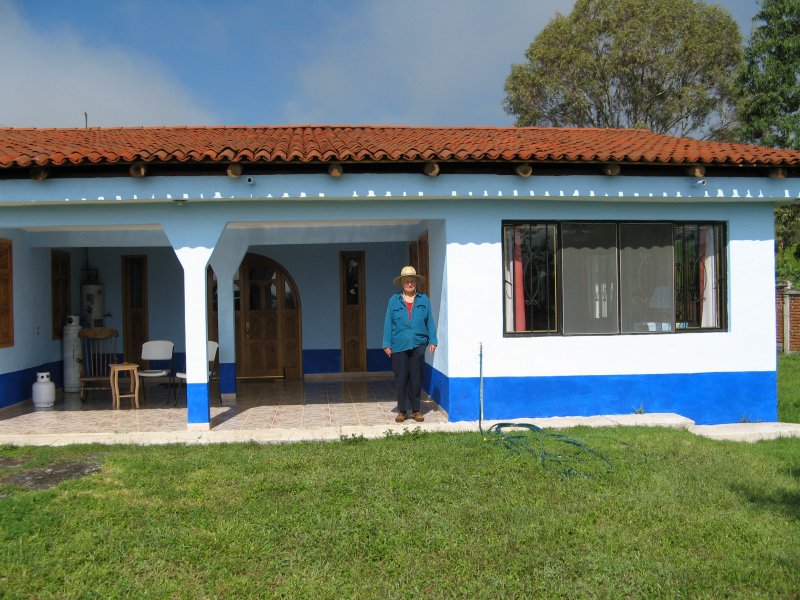
Our house as it is today
Double doors in the entryway
The living room before furnishing

The kitchen was the deal maker

The view; OH the VIEW!
The house has changed over time. Our landlords put up a new, tiled roof, at their own expense, and then when I proposed that we pay to have the house rewired (so that I could run a toaster oven and the microwave oven at once), they paid for 90% of the costs.

The local people have welcomed us. We attend many of their fiestas. We've also been to three funerals. Through these blogs, and through my Picasa web Albums, I've become the photo chronicler of the Rancho. The people who have emigrated to the Other Side (the U.S. border) enjoy seeing local events commemorated on the Web. Next wednesday, we are invited to a Graduation comida. I was asked to please bring my camera.

We have no doubt. This is the place. The right place.


Wednesday, April 27, 2011

Riding the Nostalgia Train


We had the good fortune to experience passenger train travel a few times in Mexico before the services ended around 2000. We were on the Chepe Primera Clase (Chihuahua al Pacífico)* run about 3 times. Comfortable and enjoyable; fun companions, cold cerveza and a dining car! (I didn't eat from the dining car but there were enough vendors coming aboard to sell their specialities. A steward came buy at intervals to serve us a pseudo-orange drink I quickly dubbed "Naranjanada".
A highlight was the 20 minute stop at Divisadero mirador, where ladies sold gorditas filled with chcken and other antojitos. You could even see the Barranca del Cobre!

The first train trip was from Cd. Júarez to Chihuahua, and the following year from Cd. Júarez to Zacatecas, a 24 hour trip, Pullman class car, through mostly desolate wasteland. We did make friends with an interesting family. It was fun to explore and deploy the foldout furnishings in our Pullman roomette, but after that, it was nearly unremitting boredom. We stopped for what seemed hours in the middle of nowhere. Maybe we were ahead of schedule.These are probably one reason Zacatecas looked so good, with its cobbled streets, plazas, fountains and the warm glow of the faroles de dragones. (But it is truly a wonderful city.)

Another year saw us take an overnight train from Mexico City to Oaxaca. No Pullman Service. The most exciting part of that was the boarding, with uniformed conductors to show us to our seats. After a semi sleepless night, the dawn revealed that we were in La Cañada, a scenic section of the trip, not long before arriving in Oaxaca. Another fabulous city.

For some benighted motive, we once the overnight train from Mexico City to Monterrey. It was slow, paralytically boring and uncomfortable. No Pullman Service. We slept athwart the wooden arm rests, waking with our legs like logs.

We didn't always take first class trains; an exception was another overnight trip (No Pullman Service) from Tepic, Nayarit to El Sufragio Estacíon, a connecting point to Los Mochis via 2nd class bus. That particular train coach was dark, dingy and foreboding. The restroom was either nonexistant or out of order, but it was fun to whiz off the back platform.

Even riding the First Class coaches on the Chihuahua al Pacífico, taking a wee in the WC posed a threat for the photographers and others standing in the usually fresher air of the vestibule between cars. There was a definite spray factor when the WC was flushed. It was especially noticeable as the train lurched around one of the many curves.

It's fun to look back on those days of train service, the occasional discomforts and slowness fuzzily obscured by time and nostalgia. These days, I prefer the bus. We can even choose which bad movie to watch, or none at all.

(This post was inspired by a post on Michoacán_Net by David Haun, which set off a flurry of train stories.)


Thursday, April 21, 2011

A Magic Phrase

María Dolores was our hostess at a small (2 bedrooms) guesthouse apartment in Madrid in 2002. She was a kind and caring person, but she was very careful who she admitted to her third floor piso. It was in a nondescript building on a very busy one way street, a few blocks south of the Plaza Mayor. She lived with her then 13 year old son, who played games on a Mac. We found a kinship there.

She gave us juice and homemade quick bread. The room and ensuite bath were small but clean and we were glad to find it, especially at €35, back when the dollar was at par with the euro.

When she saw that I was going to go out into the streets with my camera slung over my neck, she also gave me some advice.

The first part was that it was better not to carry valuables in a visible way.
The second piece of advice was that if anyone accosted us or asked a question, just say: “¡NO LO SÉ!” and walk on.

We never had occasion to use the phrase while we were in Madrid, as we had no problems other than be shorted 20 Euros from an ATM on the Puerta del Sol.

Last Sunday, in Mexico City's Colonia Roma, we were walking back to our hotel from a friend’s house. A dodgy looking guy suddenly stepped out and accosted us with the words, “Discúlpe la molestia, Señor...”

María Dolores’ magic phrase awoke from its long slumber.
“¡NO LO SÉ” came out of my mouth unbidden by conscious effort.
He shrank back wordlessly and we walked on.

What Spanish magic does that potent phrase contain, to work in Mexico City as in Madrid?


Tuesday, April 05, 2011

Cleaning Out the Whatsit?

Monday, I cleaned out the "Whatsit?" catch-all shelf in our trastero cabinet. We'd bought the two section trastero from a Zirahuen organic ranching couple back in 2006, and it's since served us for clothes drawers, overhead storage space, wine cellar and liquor cabinet, and as a "Whatsit?" catchall compartment.

Doña Cuevas checks the trastero when it moved in
The Whatsit? held a miscellaneous collection of flashlights, candles, mosquito coils, locks, Hallow'een masks and other junk.

Yesterday's big find were the numerous eyeglasses, in their snazzy cases, of which at least two had higher quality frames than the ones we'd gotten in Pátzcuaro. The electric extension cord and surge suppressor went out to the storage boxes in the garage. The goofy looking candle holder, mosquito coils and some other items are going to giveaways. The massive padlock which had originally been the main line of defense at our gate was defective, so we tossed it in the trash.

It was a productive and satisfying way to occupy an hour or so. We had to take a long nap afterwards, but that was partly in response to the change to Daylight Saving Time, and the previous two long but enjoyable days of house cleaning and prep for Sunday dinner.

Saturday, March 19, 2011

Seven Shots In Michoacán


This post is not about violence in Michoacán. If you were looking for that, you might instead go here.

No, this is about some of the free or inexpensive health care available to both Mexicanos and Gringos living here. No ifs, ands or buts.

Thursday, March 03, 2011

Hoopla On the Rancho

A couple of the preteen neighbor kids came over one evening last week. Andrés is especially inquisitive and likes to chat with us in Spanish. Both he and Alejandro were carrying a Mexican, homemade version of a Hula Hoop. The hoops are made of stiff lengths of hose, with a metal piece jammed into one end so it may be mated to the other end. These "aros", or hoops, are slightly smaller in diameter and a bit heavier than the commercial model Hula Hoops I recall. I was pleased to see that these toys or exercise devices are made from low cost, surplus materials.

They then proceeded to enthusiastically demonstrate how the hoops are used. Andrés also had a jump rope (video link).

Andrés and Alejandro
Our amiga down the street told us later that the hoops are used as part of the schools' physical fitness program. In an effort to combat obesity, the Mexican government is instituting new measures in the schools, among which fresh fruit stands are set up to tempt the children. What will the comida chatarra (junk food) vendors do? Papitas (potato chips), dulces, refrescos, chicharrones are an integral part of the Mexican food culture.

After the PE demos, we sat and chatted a while of life here and al otro lado (in the U.S.), until the air grew cool and the sun began to set. We enjoy these occasional chats with these kids. It will be our turn for Show and Tell next time.

Friday, February 04, 2011

Twisted Taxi Tales


During the many years we've visited and lived in Mexico, most of the taxi rides we've taken were free of any unusual incidents. But there have been some exceptions.

The stories you are about to read are true; only the names of the drivers are omitted because we never knew them. No crimes were committed, but we have been subjected to pendejadas. In the following series of Twisted Taxi Tales, up to five Pendejada Points (¶) will be awarded to qualified taxistas.

Monday, January 17, 2011

Pemeces* Past and Present

Old Pemex Gasolinera, C/ Federico Tena at C/ Navarrete
You could get your hair permed, your skin tattooed and your car greased. That was when we arrived here in October, 2005. Gas was no longer available.

Today, a new Pemex is arising. The final construction touches are underway. We don't know what it will offer, apart from gas, oil and air. I'm betting that no tattoos will be available, except accidentally. Maybe there will be an OXXO, or a Happy Go store. You can buy a lot of handy things in those stores. Look for the hotdog specials! You can get a premixed alcoholic beverage in a can!

We miss the old Pemex, a classic of Mission style Mexican Architecture. It occasionally provided us with cheap or free parking. The lube rack pits were totally unguarded by any safety rails. No risk to me, as I never went inside.

New Pemex plaza

Shade for your vehicle
*Pemeces: plural form of Pemex

Friday, January 14, 2011

Three Guys and a Ladder

Today, Doña Cuevas is our Guest Blogger. Editing and composition by Don Cuevas.


(This really happened. We are not making it up.)


Doña Cuevas writes:
"Last week I went up the road to visit and lunch with 2 amigas Norteamericanas coming from Morelia for shopping. I met them at a roadside restaurant we lovingly call Larry's Fish House (because our ex-neighbor Larry liked to eat there when he lived here.)"
(Don Cuevas says: "Mediocre food, great view. They often seem to go together. However, the hand made tortillas are good and the salsa de molcajete can be tasty.")


Doña Cuevas continues:
"I looked out the window, as we sat eating our shrimp dishes, and there
were 3 guys.They were attempting to repair a light fixture high above the ground. Two of them were steadying a 12-16 ft. wooden ladder, with no support, for the 3rd man, who was about 12 ft. up the ladder. He realized he couldn't reach the outside light, and came down." 


"I looked out later and there was a Pepsi truck backed up, with the
same third guy climbing up the ladder (which now had its top resting on
the back of the truck) with a plastic chair in his hands. He climbed
up on the chair, which sat upon the roof of the Pepsi truck, but it was still not high enough."


A Pepsi truck something like this one.


"One of the other guys brought a sturdy plastic bucket (like a pickle bucket) and pitched it up to the guy on the roof of the truck.
He placed upside down on the chair seat. He climbed up but it was still not high enough, but by standing on his toes he could reach the top of the light fixture and start unscrewing the top part."


"We left at that point, but I'd bet that the fixture was unscrewed,
the man came down off the Pepsi truck with the fixture, the necessary
parts were not available to fix the light, and the Pepsi truck drove
off with driver at the wheel. The Pepsi truck, or a similar truck,
would return another day and the light would be reinstalled, to work
until someone shot out the bulb and the bulb covering."


"It never gets boring around here, at least for me."


"Saludos cariñosos,
 Doña Cuevas"

Monday, September 20, 2010

The Bicentenario Celebrations in Pátzcuaro


We don't usually attend nighttime events in Pátzcuaro, as we live way out in the country and don't like to drive at night. I'm also in the habit of going to bed early and arising very early.

But as this was Mexico's Bicentenario year, we decided to attend both La Noche del Grito on Wednesday, Sept. 15 and the next day's Independence Day celebrations.

Saturday, September 18, 2010

Our Gated Community

Following up on my previous post "Don't Forget To Take Out The Trash", here is the latest news on the trash dump news front.

Wednesday evening saw the first known garbage truck dump its load in the new basurero. We weren't there to see it, as we were in Pátzcuaro to celebrate La Noche del Grito and El Día de La Independencia.

Friday, September 10, 2010

Things That Go Bump In The Road

Not a bra! Slow down!

Full stop!
Anyone familiar with driving in Mexico knows what "topes" are: speed bump barriers to excessive velocity as well as tranquility. There are various forms of topes, ranging from the basic raised ridge to metal plates set into the pavement and the elegant "reductor de velocidad" along Morelia's Avenida Camelinas. Then there's the racy "vibradores", a series of corrugations sometimes known in the U.S. as "rumble strips". In ritzy Montclair, NJ, they have "speed humps".

But there are lesser known variants of topes, which I'll describe. Poor communities, which don't have the funds to install raised barriers, sometimes just make a short and steep ditch, a negative space I dubbed a "nope". That's pronounce "NO-pay". In the hardscrabble outlying burg of Tzurumutaro, the back street sports concrete tank barriers that could be called "golpes", Spanish for "hit" or "blow" in the hurting sense. Those are best negotiated by flanking maneuvers when possible and when that's not feasible, a slow aproach at an angle may allow your vehicle to pass without damage. In pleasant contrast, the highway bypassing Tzurumutaro to one side has two of the most gradual and gentle tope mounds ever seen. Crossing them is like eating Mallomars candy.


In a labyrinthine colonia in lower Pátzcuaro, the not recommended route to the Panadería La Espiga includes a horrendous tank trap with a vicious, protruding reinforcing rod. Other routes are advised, or foot travel only. I recommend hiring a knowledgeable guide for your first visit to the Panadería. Contact me.

Possibly you like topes; maybe you want to experience the "Real Mexico". If that's the case, I recommend a drive to Morelia's International Airport, close to the town of Álvaro Obregón. There are something like 27 topes between the turnoff from the main highway out of Morelia and the Airport entrance gate. What's not to like?
After a reckless encounter with topes, you may need this Tope's Auto Repair.

I have now found what I think is the ultimate topes nightmare.

Thursday, September 09, 2010

Don't Forget To Take Out The Trash


Sometimes changes take place quickly, and one's point of view changes just as fast. That happened this week, all within a very short time span.

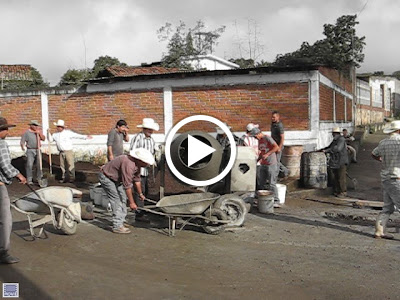
Lately there has been an unusual amount of public works activity here in our pueblecito. There's a crew of citizens, both young and old, working on widening the road near where it meets or roughly paved street. All that cooperative community work gladdened my heart. Perhaps our street would be the next to be resurfaced?


(Doña Cuevas says that if it were improved, vehicles would be racing up and down it. In my opinion, God gave us topes for that very purpose.)

Click to go to video

But as the work progressed on the road widening below our house, there came the disquieting roar of heavy rock and gravel hauling trucks passing our house and returning empty. We live a few meters from the end of the pavement, where the gravelled stretch inclines lazily up the ridge.

Geni Certain photo
There are some nice views from there. Until a few years ago, the gravelled road was a horrendous bog of cow paths wandering from boulder to boulder by way of mudholes. Now, it's a nice walk.

You have to look out for the odd, dead and rotting animal just beyond the picturesque stone walls. This month's special is a smelly, dead cow. But these carrion are ephemeral. Given a month or two, they are reduced to bones by decay and coyotes.

The other evening, rumor flew to us via cell phone that the enterprising gentleman who'd improved the road, and late last year had 7 power poles installed and extended to his property up the way, was planning to have the municpal trash dump placed up on his terreno. It's entirely possible. Our informant told us that all the other local inhabitants are against the plan. A petition was circulated among the local gente. I was asked by an expat amiga whether one person's will could prevail against a majority of popular opposition. Sure it could. Depends.

Don't forget to take out the trash

We await the outcome. Updates will surely follow.

UPDATE September 10, 2010: We have been unable to drive in or out of our street for 2 days, while the concrete sets at the foot of the street. Yesterday, we used the combi vans to go out and into Pátzcuaro. It was easy going out, but we had to wait nearly an hour coming back, arriving in a deluge of rain. We walked up in a small graywater rapids to our gate.

It occurred to me that the street improvements might be in a large part for the benefit of heavy trucks that otherwise could not pass the "nope", my neologism for "negative tope" at the foot of the narrow street, and the widening is intended for waiting trucks to layby until their turn to haul their loads upward.

UPDATE September 12, 2010: we didn't have our regular trash pickup last Wednesday. I assumed that that was because the new concrete was being poured at the foot of our street, and the trash truck couldn't cross it. But now it seems as though the trash collectors are boycotting our pueblo in protest of the proposed new trash dump up the road from us. The new dump might cut into their regular routes. I don't know exact details, or what, exactly, is going on.

Power to the people!

New gate to the proposed project area
                                        The Fine Print:
I am forbidden by the Mexican Constitution and the laws governing my migratory status to engage in any political activity, sign petitions, and perhaps even comment negatively or positively on such issues. I've gone over this post with the proverbial fine-toothed comb, looking for any indications that might reveal my sentiment on this subject. I'm sure that none can be found. I leave the rest to your imagination.

Saturday, September 04, 2010

Glorious Anniversary of Five Year Plan


We arrived to live in Mexico on September 14, 2005.
We now approach the Glorious Anniversary of our first Five Year Plan.
Last week, we completed our applications for our second FM3 visas.
On Wednesday we went to pick them up. Now they are laminated cards instead of passport like booklets.

OLD
NEW
We celebrated the beginning of our second Glorious Five Year Plan with a nice seafood lunch at La Jaiba.

Yummy!
Five years ago crossed the frontera just before dawn on September 14, 2005, and got to to Morelia a couple of days earlier, and not without some car problems.

We obtained temporary housing over the cold winter of 2005-2006, then house sat for 4 months in the spring of 2006. Then in June 2006, we found our present home waiting for us. It was outwardly unattractive but inside it was a gem. Since then, it has been variously improved by the owners: new roof, paint and rewiring. Our rent has risen only 500 pesos in the 4 years we've been here. Knock knock. Recently, the monthly charge for pueblo piped water rose from $50 to $70 pesos.


The rancho/village in which we live has recently gotten funding and a community effort public works project is under way right now. The hub of the pueblo at the crosswalk has been widened.


We felt the spirit move us, and with a gift of utility shelving from dear, departed friends, we reorganized or garage! ¡Que milagro!

Could be turned into a guestroom or a small store!
A couple of years ago, the rough, upaved cowtrail that was the upward extension of our street was bulldozed and graveled. Last year, seven concrete poles were placed to carry current upward to a projected house site. We don't like the poles, as the spoil the view, but hey! It's not our land.

Pole Land

A new tienda opened at the entrance to the pueblo about 6 months ago. It's a progressive, modern store, allowing the customers to come inside and actually see and perhaps handle the merchandise before buying. The other tiendas here have little windows where you knock, ring, push a bell and you ask for whatever dusty, out of date article you desire. This should quiet and calm (but it won't) the critics of Big Supermarkets who fear that those threaten the small, Mamá y Papá tiendas. We have at least 5 tiendas in our pueblecito. Some are hidden away on side streets, serving the neighborhood.

The 3 kilometers of paved road in from the main highway has had its potholes patched a couple of times. Keep up the good work. We like being able to drive in and out without swerving to avoid potholes.

This is a good place for us, and we hope to enjoy at least another 5 years here.